
Built a structured strategy layer that turned workforce data into decision-ready recommendations.
Designed a structured AI system to translate data into strategy
Replaced analyst-dependent workflows with scalable AI guidance
Constrained AI outputs to ensure reliability and trust
Repositioned the product from insight delivery to decision support (Aligning with overall business strategy)
Traditional labor market platforms help users understand what’s happening.
They break when users need to decide what to do next.
At TalentNeuron, customers relied on the platform for data but depended on analysts and offline workflows to build strategy.
I led the transformation of the Market Intelligence platform into a system that generates strategic decisions through an AI-powered capability layer.
the real problem
Reducing Dependency, Enabling Strategy in the System
The problem wasn’t expert analysts. It was the absence of a system that could generate strategy without them.
The platform provided strong labor market insights.
But every strategic decision still required interpretation outside the product.
Across customer conversations and internal workflows, we saw a consistent pattern:
Users explored data but stopped short of action
Strategic decisions were taken offline
Analysts became a required step in the process
What This Meant
Strategy required offline workflows
Exploration was limited by time, cost, and analyst availability
Users couldn’t evaluate multiple strategic paths independently
“We use the platform for data, but strategy still happens in PowerPoint.”
Reframing the Problem
We initially approached this as an automation problem. But that wasn’t the right framing.
The goal wasn’t to replace experts.It was to make strategy possible within the system itself.
AI Constraint
This also exposed a critical limitation for AI.
Without a structured system connecting data to decisions:
• AI outputs would be inconsistent
• Recommendations would lack context
• Trust would break down quickly
AI couldn’t generate reliable strategy without a governed foundation.
What Needed to Change
To enable strategy within the product, the system needed to:
• Enable users to explore multiple strategic options independently
• Translate insights into decisions through structured system logic
• Support decision-making before expert engagement
Strategy wasn’t missing. It was unstructured, and therefore couldn’t exist in the system.
Journey Map created to follow the user’s workflow and identify opportunity
Shifting the Product’s Role
Making Strategy Computable
I transformed a labor market intelligence platform into a system that generates strategic decisions, not just insights.
The platform already provided strong insights across labor market data. But without a structured capability layer, there was no consistent way to translate those insights into strategic action.
Through product reviews and user conversations, we saw the same pattern:
- Users could identify trends
- But they couldn’t confidently decide what to do next
- Strategy depended on expert interpretation, not system support
“We still need to take this offline and figure out what it means.”
Key Insight
We realized the problem wasn’t insight quality.
It was the absence of a system that connects data to decisions.
Without that:
• Insights remained disconnected from action
• Strategy lived outside the product
• AI had no structured layer to operate on
New Concept
To solve this, I introduced a structured capability layer:
A system-level framework that:
- Maps signals to strategic capabilities
- Translates data into decision pathways
- Provides a foundation for AI to operate reliably
This shifted strategy from:
- something interpreted externally
- to something generated within the system
Product Role Transformation
Before: No Capability Layer
Insights disconnected from action
Strategy required expert interpretation
No consistent mapping from signals to decisions
AI lacked structure and produced inconsistent outputs

After: Capability Layer Introduced
Insights mapped to strategic capabilities
Strategy generated within the product
Consistent translation from signals to decisions
AI operates on structured, governed logic
Strategy didn’t become faster. It became computable.
new product direction
Reframing the Product
I shifted the product from delivering insights to making strategy possible within the system.
The product delivered strong labor market data, but it had no way to represent strategy. As a result, users were expected to interpret insights and construct decisions themselves.
I challenged this direction and reframed the problem:
Instead of asking:
“What insights should we show?”
We aligned around a different question:
“How can strategy be structured so the system can generate it?”
This shift led to a new product model:
• Strategy is not something users assemble manually
• It must be structured so it can exist within the system
• Insights alone are not enough without a layer that connects them to decisions
To support this, I aligned product, UX, and data science around a shared goal:
Turning labor market data into structured, decision-ready strategy
This reframing changed how we approached:
• Feature prioritization → Focus on decision-making, not data display
• System design → Introduce a capability layer to connect signals to actions
• AI’s role → Operate on structured strategy, not raw insights
This was the turning point: strategy could not scale until it became structured and representable.
how it works
The Strategy Model
The system turns market signals into strategy by structuring them into strategic drivers and capabilities.
To make this possible, I introduced a taxonomy, developed in collaboration with internal advisors and analysts, to ensure the system reflects real-world expertise.
• Strategic Drivers represent high-level business objectives
• Capabilities represent the actionable areas that support those objectives
Together, they define how strategy exists within the product.
Instead of generating answers from raw data, the system operates on this expert-informed framework.
Market signals across roles, skills, locations, and competitors are mapped to capabilities, grouped under strategic drivers, and assembled into decision-ready outputs.
Each output is grounded in curated expertise, not just data.
AI does not create strategy. It operates on it.
The capability layer encodes expert logic. AI orchestrates it.
Before, strategy had to be interpreted by experts.
Now, expert thinking is embedded into the system.
This system doesn’t replace experts. It scales their thinking.
the system
Making Strategy Computable
I introduced a capability layer that made strategy representable, and therefore generatable, within the product.
This layer sits between raw data and the user experience, structuring signals into strategic capabilities the system can interpret, connect, and act on.
Without it, strategy could not exist in the system. With it, strategy becomes computable.
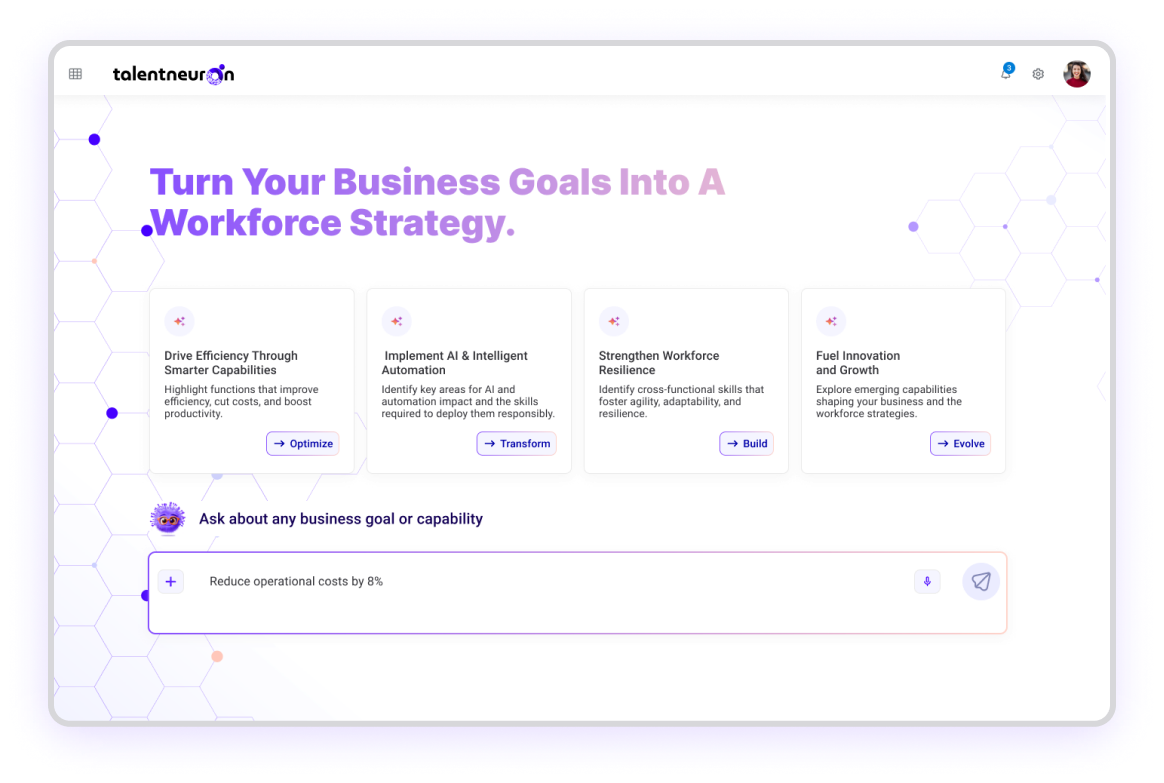
How it worksThis layer sits between raw data and the user experience, structuring signals into strategic capabilities the system can interpret, connect, and act on.
Instead, the system guides them through a structured decision flow:
- Start with a business goal or hiring objective
- Provide context (role, job description, location preferences)
- Explore structured strategic pathways tied to that goal
The system translates intent into relevant capabilities, giving users a clear starting point for decision-making.
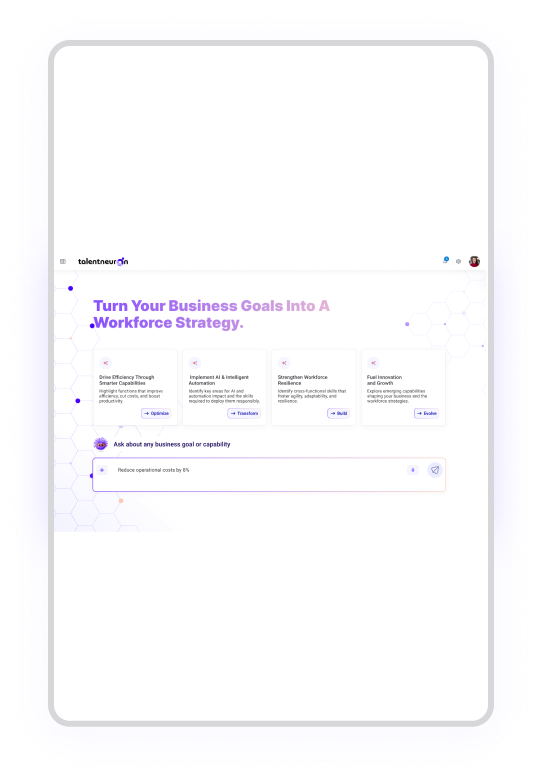
Capability cards = entry points into structured strategy
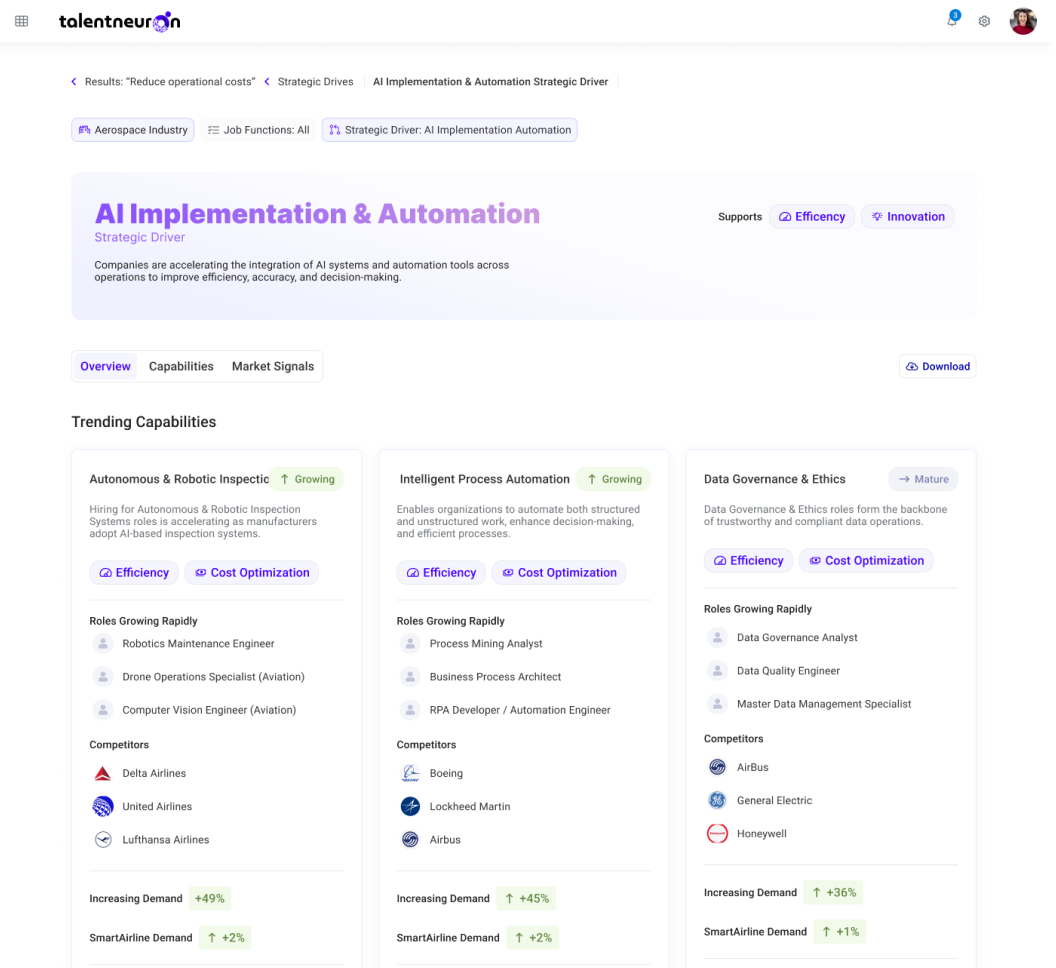
From Insight to Decision Context
Instead of analyzing disconnected data points like:
• Which companies are investing
• What roles are growing
• What tradeoffs exist
Capabilities act as the organizing layer:
• Connecting signals across roles, skills, locations, and competitors
• Framing insights around business objectives
• Surfacing tradeoffs in a comparable, structured way
Instead of interpreting raw data, users receive decision-ready views grounded in strategic context.
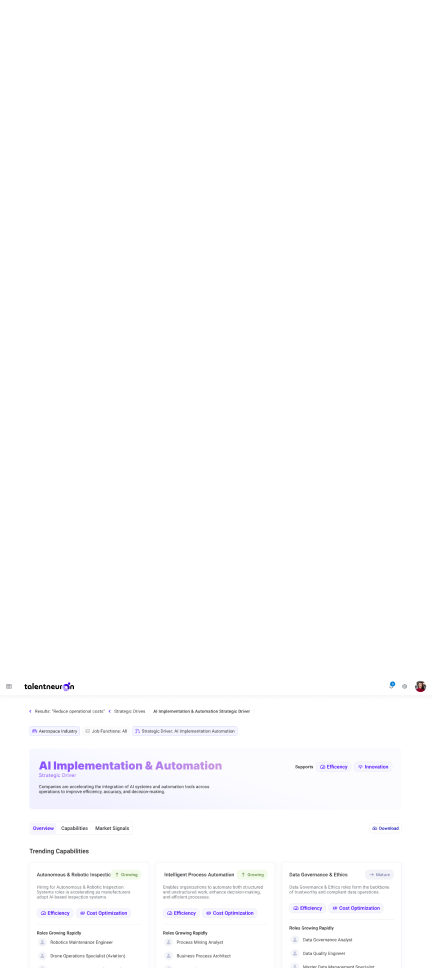
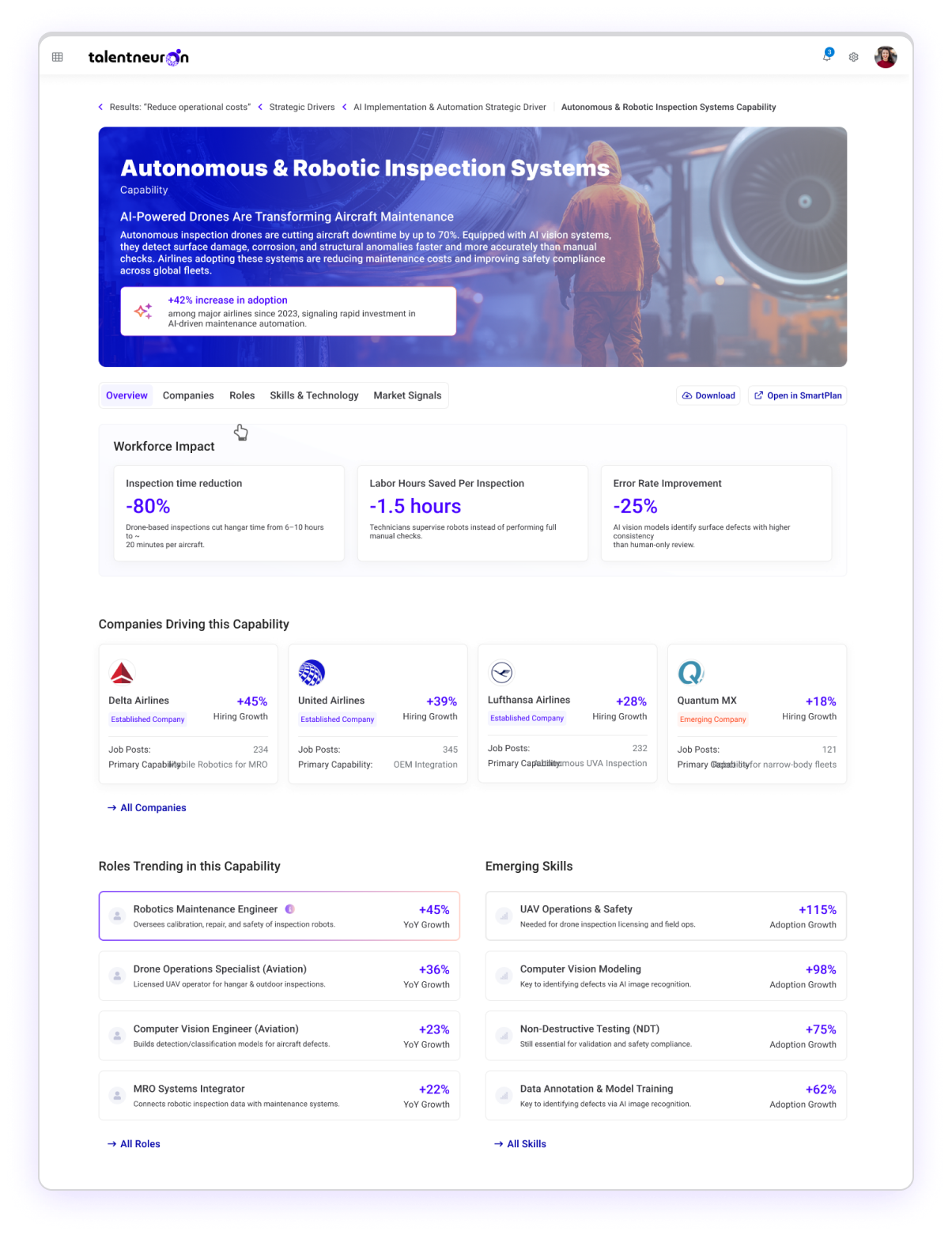
Expert Judgment × AI Amplification
The role of AI:
AI does not generate strategy from scratch.
It operates on structured logic defined by the capability layer.
It acts as an orchestration layer that:
- Identifies the most relevant signals
- Connects related insights across domains
- Assembles outputs into decision-ready views
This system turns strategy from something interpreted by experts into something users can explore and act on directly within the product.
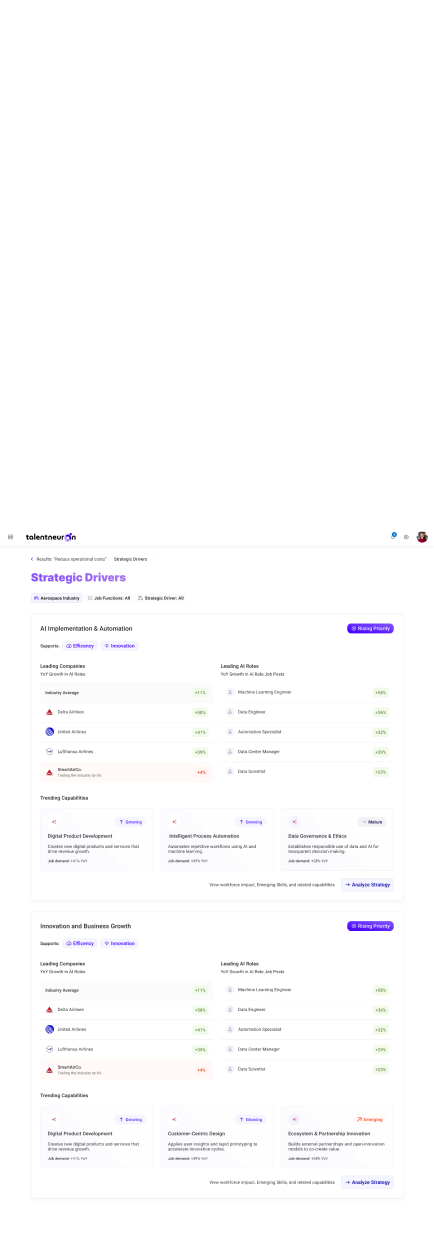
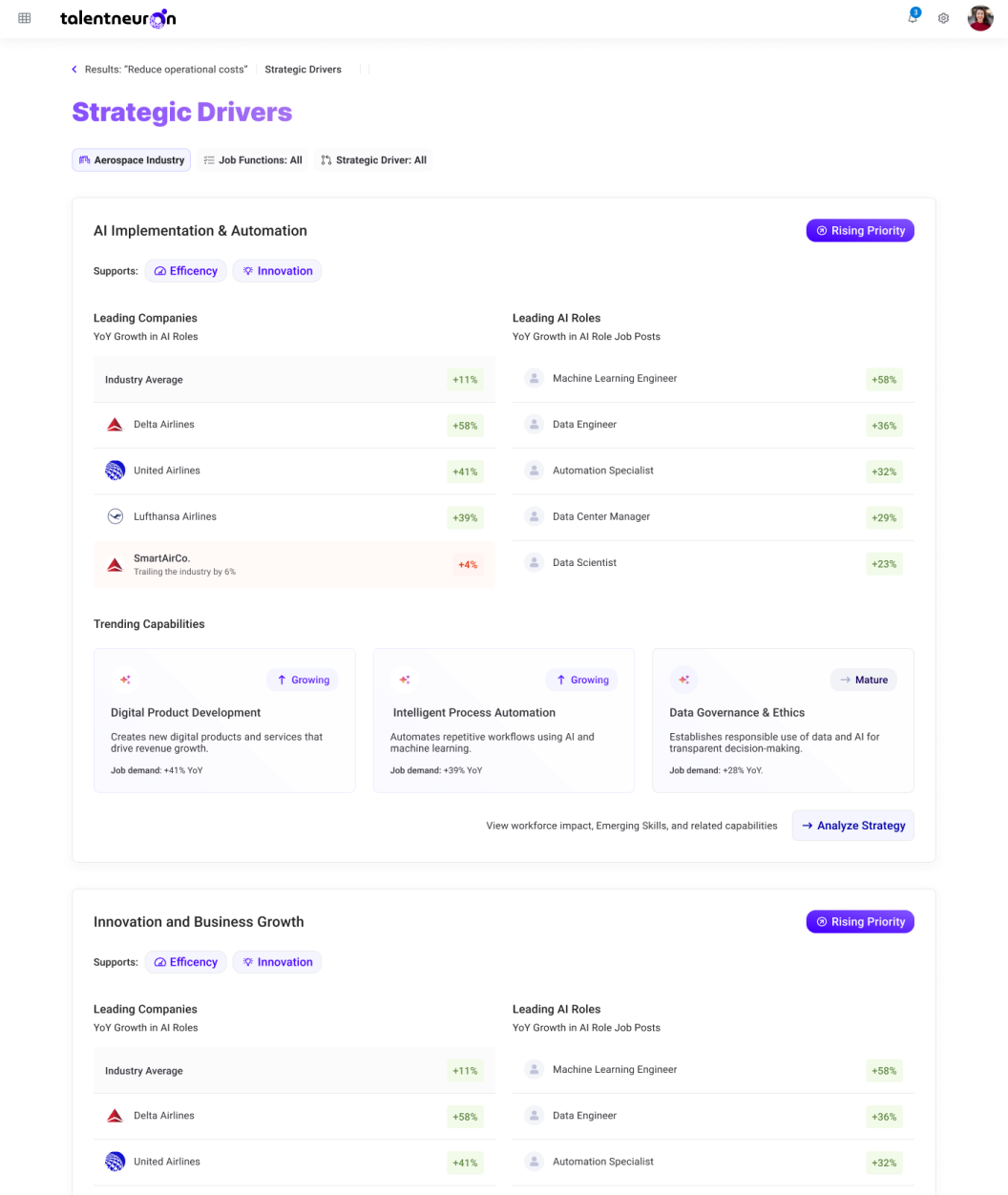
- Strategic drivers = decision lens
- Not dashboards → decision context
This system turned strategy from something interpreted by experts into something generated by the product.
Product Impact
This work repositioned the product from a data provider to a decision-support system.
By shifting the product from insight delivery to decision enablement, we fundamentally changed how it creates value for users and the business.
Previously, the platform was used as a reference tool, something users consulted for data, but relied on external workflows to act on it.
After this transformation, the product became a core part of the decision-making process.
What Changed
• From a data provider → to a decision-support system
• From a passive tool → to an active strategic partner
• From modular insights → to integrated workflows
Why It Matters
- Strategy is now created within the product, not outside of it
- Users can explore options and evaluate tradeoffs in real time
- Early-stage decision-making no longer depends on analyst availability
Foundation for Growth
- Enables AI-driven personalization based on user intent
- Scales strategy workflows across roles, regions, and use cases
- Expands into broader workforce planning and transformation scenarios
Internally, this work aligned product, UX, and data science around a clearer direction, moving away from incremental feature development toward building a system that delivers measurable strategic value.
The product no longer delivers information. It generates decisions.
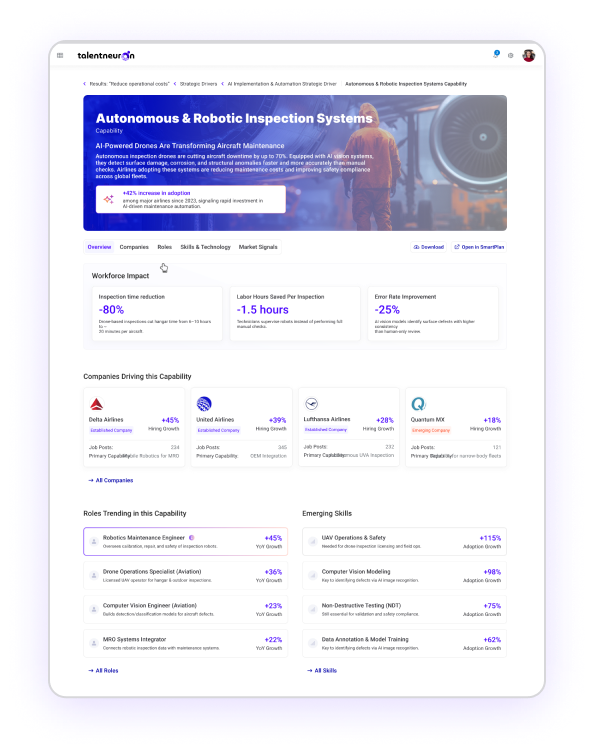
Reflection
This work reinforced that data alone does not create value, decisions do.
Data doesn’t create value. Decisions do.
The biggest shift in this project wasn’t the data, it was how strategy was structured and applied.
For years, the focus had been on expanding access to insights. But more data only increases the burden of interpretation.
Value is created when users can confidently decide what to do next.
Ultimately, the opportunity isn’t just to build better tools.
It’s to build systems that make decision-making scalable.
© 2026 Daniel Merino
Product & Ux Strategy
Built a structured strategy layer that turned workforce data into decision-ready recommendations.
Designed a structured AI system to translate data into strategy
Replaced analyst-dependent workflows with scalable AI guidance
Constrained AI outputs to ensure reliability and trust
Repositioned the product from insight delivery to decision support (Aligning with overall business strategy)
Traditional labor market platforms help users understand what’s happening.
They break when users need to decide what to do next.
At TalentNeuron, customers relied on the platform for data but depended on analysts and offline workflows to build strategy.
I led the transformation of the Market Intelligence platform into a system that generates strategic decisions through an AI-powered capability layer.
the real problem
Reducing Dependency, Enabling Strategy in the System
The problem wasn’t expert analysts. It was the absence of a system that could generate strategy without them.
The platform provided strong labor market insights.
But every strategic decision still required interpretation outside the product.
Across customer conversations and internal workflows, we saw a consistent pattern:
Users explored data but stopped short of action
Strategic decisions were taken offline
Analysts became a required step in the process
What This Meant
Strategy required offline workflows
Exploration was limited by time, cost, and analyst availability
Users couldn’t evaluate multiple strategic paths independently
“We use the platform for data, but strategy still happens in PowerPoint.”
Reframing the Problem
We initially approached this as an automation problem. But that wasn’t the right framing.
The goal wasn’t to replace experts.It was to make strategy possible within the system itself.
AI Constraint
This also exposed a critical limitation for AI.
Without a structured system connecting data to decisions:
• AI outputs would be inconsistent
• Recommendations would lack context
• Trust would break down quickly
AI couldn’t generate reliable strategy without a governed foundation.
What Needed to Change
To enable strategy within the product, the system needed to:
• Enable users to explore multiple strategic options independently
• Translate insights into decisions through structured system logic
• Support decision-making before expert engagement
Strategy wasn’t missing. It was unstructured, and therefore couldn’t exist in the system.
Journey Map created to follow the user’s workflow and identify opportunity
Shifting the Product’s Role
Making Strategy Computable
I transformed a labor market intelligence platform into a system that generates strategic decisions, not just insights.
The platform already provided strong insights across labor market data. But without a structured capability layer, there was no consistent way to translate those insights into strategic action.
Through product reviews and user conversations, we saw the same pattern:
- Users could identify trends
- But they couldn’t confidently decide what to do next
- Strategy depended on expert interpretation, not system support
“We still need to take this offline and figure out what it means.”
Key Insight
We realized the problem wasn’t insight quality.
It was the absence of a system that connects data to decisions.
Without that:
• Insights remained disconnected from action
• Strategy lived outside the product
• AI had no structured layer to operate on
New Concept
To solve this, I introduced a structured capability layer:
A system-level framework that:
- Maps signals to strategic capabilities
- Translates data into decision pathways
- Provides a foundation for AI to operate reliably
This shifted strategy from:
- something interpreted externally
- to something generated within the system
Product Role Transformation
Before: No Capability Layer
Insights disconnected from action
Strategy required expert interpretation
No consistent mapping from signals to decisions
AI lacked structure and produced inconsistent outputs
After: Capability Layer Introduced
Insights mapped to strategic capabilities
Strategy generated within the product
Consistent translation from signals to decisions
AI operates on structured, governed logic
Strategy didn’t become faster. It became computable.
new product direction
Reframing the Product
I shifted the product from delivering insights to making strategy possible within the system.
The product delivered strong labor market data, but it had no way to represent strategy. As a result, users were expected to interpret insights and construct decisions themselves.
I challenged this direction and reframed the problem:
Instead of asking:
“What insights should we show?”
We aligned around a different question:
“How can strategy be structured so the system can generate it?”
This shift led to a new product model:
• Strategy is not something users assemble manually
• It must be structured so it can exist within the system
• Insights alone are not enough without a layer that connects them to decisions
To support this, I aligned product, UX, and data science around a shared goal:
Turning labor market data into structured, decision-ready strategy
This reframing changed how we approached:
• Feature prioritization → Focus on decision-making, not data display
• System design → Introduce a capability layer to connect signals to actions
• AI’s role → Operate on structured strategy, not raw insights
This was the turning point: strategy could not scale until it became structured and representable.
how it works
The Strategy Model
The system turns market signals into strategy by structuring them into strategic drivers and capabilities.
To make this possible, I introduced a taxonomy, developed in collaboration with internal advisors and analysts, to ensure the system reflects real-world expertise.
• Strategic Drivers represent high-level business objectives
• Capabilities represent the actionable areas that support those objectives
Together, they define how strategy exists within the product.
Instead of generating answers from raw data, the system operates on this expert-informed framework.
Market signals across roles, skills, locations, and competitors are mapped to capabilities, grouped under strategic drivers, and assembled into decision-ready outputs.
Each output is grounded in curated expertise, not just data.
AI does not create strategy. It operates on it.
The capability layer encodes expert logic. AI orchestrates it.
Before, strategy had to be interpreted by experts.
Now, expert thinking is embedded into the system.
This system doesn’t replace experts. It scales their thinking.
the system
Making Strategy Computable
I introduced a capability layer that made strategy representable, and therefore generatable, within the product.
This layer sits between raw data and the user experience, structuring signals into strategic capabilities the system can interpret, connect, and act on.
Without it, strategy could not exist in the system. With it, strategy becomes computable.
How it worksThis layer sits between raw data and the user experience, structuring signals into strategic capabilities the system can interpret, connect, and act on.
Instead, the system guides them through a structured decision flow:
- Start with a business goal or hiring objective
- Provide context (role, job description, location preferences)
- Explore structured strategic pathways tied to that goal
The system translates intent into relevant capabilities, giving users a clear starting point for decision-making.
Capability cards = entry points into structured strategy
From Insight to Decision Context
Instead of analyzing disconnected data points like:
• Which companies are investing
• What roles are growing
• What tradeoffs exist
Capabilities act as the organizing layer:
• Connecting signals across roles, skills, locations, and competitors
• Framing insights around business objectives
• Surfacing tradeoffs in a comparable, structured way
Instead of interpreting raw data, users receive decision-ready views grounded in strategic context.
Expert Judgment × AI Amplification
The role of AI:
AI does not generate strategy from scratch.
It operates on structured logic defined by the capability layer.
It acts as an orchestration layer that:
- Identifies the most relevant signals
- Connects related insights across domains
- Assembles outputs into decision-ready views
This system turns strategy from something interpreted by experts into something users can explore and act on directly within the product.
- Strategic drivers = decision lens
- Not dashboards → decision context
This system turned strategy from something interpreted by experts into something generated by the product.
Product Impact
This work repositioned the product from a data provider to a decision-support system.
By shifting the product from insight delivery to decision enablement, we fundamentally changed how it creates value for users and the business.
Previously, the platform was used as a reference tool, something users consulted for data, but relied on external workflows to act on it.
After this transformation, the product became a core part of the decision-making process.
What Changed
• From a data provider → to a decision-support system
• From a passive tool → to an active strategic partner
• From modular insights → to integrated workflows
Why It Matters
- Strategy is now created within the product, not outside of it
- Users can explore options and evaluate tradeoffs in real time
- Early-stage decision-making no longer depends on analyst availability
Foundation for Growth
- Enables AI-driven personalization based on user intent
- Scales strategy workflows across roles, regions, and use cases
- Expands into broader workforce planning and transformation scenarios
Internally, this work aligned product, UX, and data science around a clearer direction, moving away from incremental feature development toward building a system that delivers measurable strategic value.
The product no longer delivers information. It generates decisions.
Reflection
This work reinforced that data alone does not create value, decisions do.
Data doesn’t create value. Decisions do.
The biggest shift in this project wasn’t the data, it was how strategy was structured and applied.
For years, the focus had been on expanding access to insights. But more data only increases the burden of interpretation.
Value is created when users can confidently decide what to do next.
Ultimately, the opportunity isn’t just to build better tools.
It’s to build systems that make decision-making scalable.
© 2026 Daniel Merino
Product & Ux Strategy
Making Workforce Strategy Computable with AI
I designed a structured AI system that transformed labor market data into decision-ready strategy, reducing reliance on analysts and compressing workflows from weeks to minutes.
Built a structured strategy layer that turned workforce data into decision-ready recommendations.
Designed a structured AI system to translate data into strategy
Replaced analyst-dependent workflows with scalable AI guidance
Constrained AI outputs to ensure reliability and trust
Repositioned the product from insight delivery to decision support (Aligning with overall business strategy)
Traditional labor market platforms help users understand what’s happening.
They break when users need to decide what to do next.
At TalentNeuron, customers relied on the platform for data but depended on analysts and offline workflows to build strategy.
I led the transformation of the Market Intelligence platform into a system that generates strategic decisions through an AI-powered capability layer.
the real problem
Reducing Dependency, Enabling Strategy in the System
The problem wasn’t expert analysts. It was the absence of a system that could generate strategy without them.
The platform provided strong labor market insights.
But every strategic decision still required interpretation outside the product.
Across customer conversations and internal workflows, we saw a consistent pattern:
Users explored data but stopped short of action
Strategic decisions were taken offline
Analysts became a required step in the process
What This Meant
Strategy required offline workflows
Exploration was limited by time, cost, and analyst availability
Users couldn’t evaluate multiple strategic paths independently
“We use the platform for data, but strategy still happens in PowerPoint.”
Reframing the Problem
We initially approached this as an automation problem. But that wasn’t the right framing.
The goal wasn’t to replace experts.It was to make strategy possible within the system itself.
AI Constraint
This also exposed a critical limitation for AI.
Without a structured system connecting data to decisions:
• AI outputs would be inconsistent
• Recommendations would lack context
• Trust would break down quickly
AI couldn’t generate reliable strategy without a governed foundation.
What Needed to Change
To enable strategy within the product, the system needed to:
• Enable users to explore multiple strategic options independently
• Translate insights into decisions through structured system logic
• Support decision-making before expert engagement
Strategy wasn’t missing. It was unstructured, and therefore couldn’t exist in the system.
Journey Map created to follow the user’s workflow and identify opportunity
Shifting the Product’s Role
Making Strategy Computable
I transformed a labor market intelligence platform into a system that generates strategic decisions, not just insights.
The platform already provided strong insights across labor market data. But without a structured capability layer, there was no consistent way to translate those insights into strategic action.
Through product reviews and user conversations, we saw the same pattern:
- Users could identify trends
- But they couldn’t confidently decide what to do next
- Strategy depended on expert interpretation, not system support
“We still need to take this offline and figure out what it means.”
Key Insight
We realized the problem wasn’t insight quality.
It was the absence of a system that connects data to decisions.
Without that:
• Insights remained disconnected from action
• Strategy lived outside the product
• AI had no structured layer to operate on
New Concept
To solve this, I introduced a structured capability layer:
A system-level framework that:
- Maps signals to strategic capabilities
- Translates data into decision pathways
- Provides a foundation for AI to operate reliably
This shifted strategy from:
- something interpreted externally
- to something generated within the system
Product Role Transformation
Before: No Capability Layer
Insights disconnected from action
Strategy required expert interpretation
No consistent mapping from signals to decisions
AI lacked structure and produced inconsistent outputs
After: Capability Layer Introduced
Insights mapped to strategic capabilities
Strategy generated within the product
Consistent translation from signals to decisions
AI operates on structured, governed logic
Strategy didn’t become faster. It became computable.
new product direction
Reframing the Product
I shifted the product from delivering insights to making strategy possible within the system.
The product delivered strong labor market data, but it had no way to represent strategy. As a result, users were expected to interpret insights and construct decisions themselves.
I challenged this direction and reframed the problem:
Instead of asking:
“What insights should we show?”
We aligned around a different question:
“How can strategy be structured so the system can generate it?”
This shift led to a new product model:
• Strategy is not something users assemble manually
• It must be structured so it can exist within the system
• Insights alone are not enough without a layer that connects them to decisions
To support this, I aligned product, UX, and data science around a shared goal:
Turning labor market data into structured, decision-ready strategy
This reframing changed how we approached:
• Feature prioritization → Focus on decision-making, not data display
• System design → Introduce a capability layer to connect signals to actions
• AI’s role → Operate on structured strategy, not raw insights
This was the turning point: strategy could not scale until it became structured and representable.
how it works
The Strategy Model
The system turns market signals into strategy by structuring them into strategic drivers and capabilities.
To make this possible, I introduced a taxonomy, developed in collaboration with internal advisors and analysts, to ensure the system reflects real-world expertise.
• Strategic Drivers represent high-level business objectives
• Capabilities represent the actionable areas that support those objectives
Together, they define how strategy exists within the product.
Instead of generating answers from raw data, the system operates on this expert-informed framework.
Market signals across roles, skills, locations, and competitors are mapped to capabilities, grouped under strategic drivers, and assembled into decision-ready outputs.
Each output is grounded in curated expertise, not just data.
AI does not create strategy. It operates on it.
The capability layer encodes expert logic. AI orchestrates it.
Before, strategy had to be interpreted by experts.
Now, expert thinking is embedded into the system.
This system doesn’t replace experts. It scales their thinking.
the system
Making Strategy Computable
I introduced a capability layer that made strategy representable, and therefore generatable, within the product.
This layer sits between raw data and the user experience, structuring signals into strategic capabilities the system can interpret, connect, and act on.
Without it, strategy could not exist in the system. With it, strategy becomes computable.
How it worksThis layer sits between raw data and the user experience, structuring signals into strategic capabilities the system can interpret, connect, and act on.
Instead, the system guides them through a structured decision flow:
- Start with a business goal or hiring objective
- Provide context (role, job description, location preferences)
- Explore structured strategic pathways tied to that goal
The system translates intent into relevant capabilities, giving users a clear starting point for decision-making.
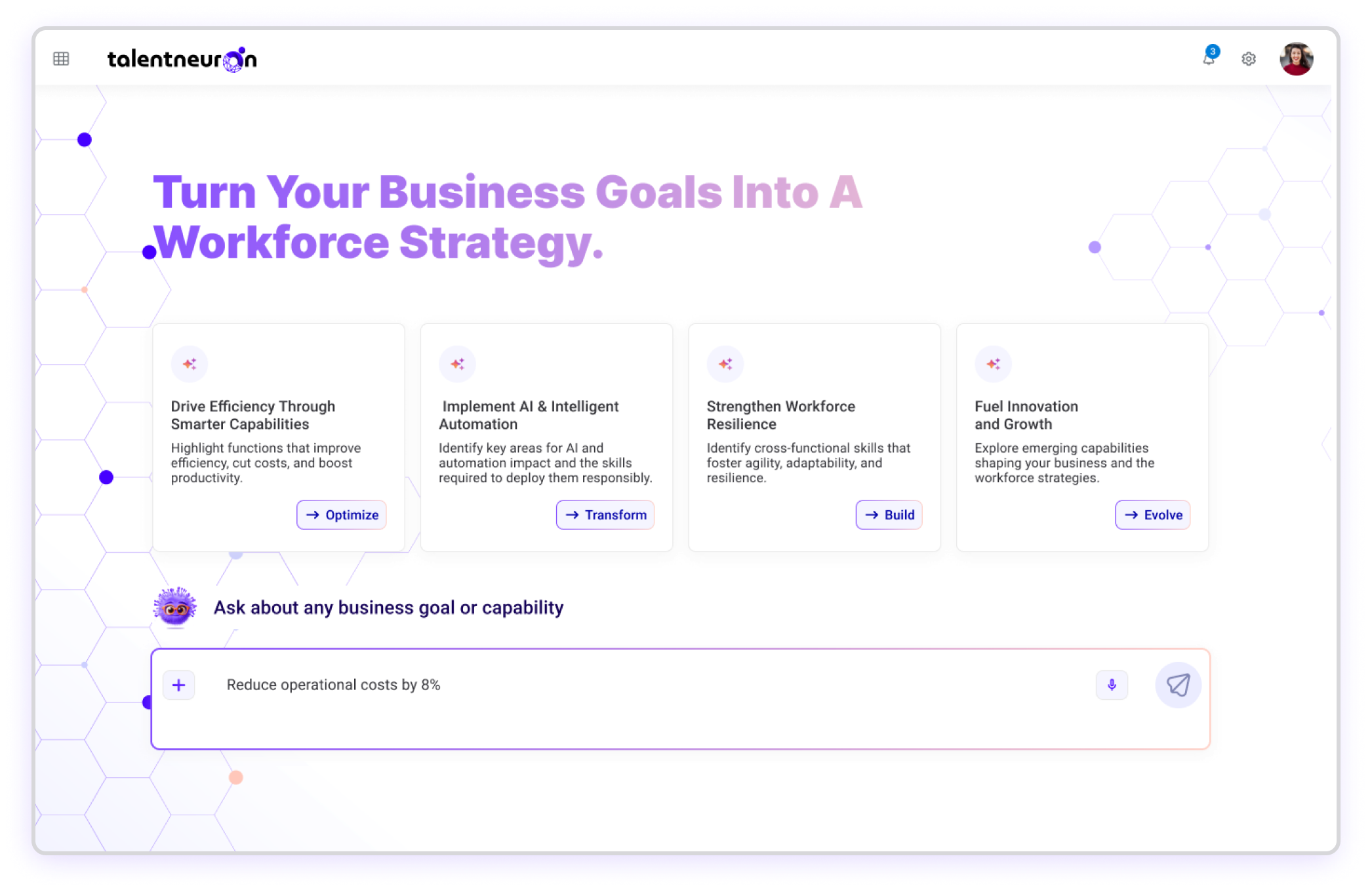
Capability cards = entry points into structured strategy
From Insight to Decision Context
Instead of analyzing disconnected data points like:
• Which companies are investing
• What roles are growing
• What tradeoffs exist
Capabilities act as the organizing layer:
• Connecting signals across roles, skills, locations, and competitors
• Framing insights around business objectives
• Surfacing tradeoffs in a comparable, structured way
Instead of interpreting raw data, users receive decision-ready views grounded in strategic context.
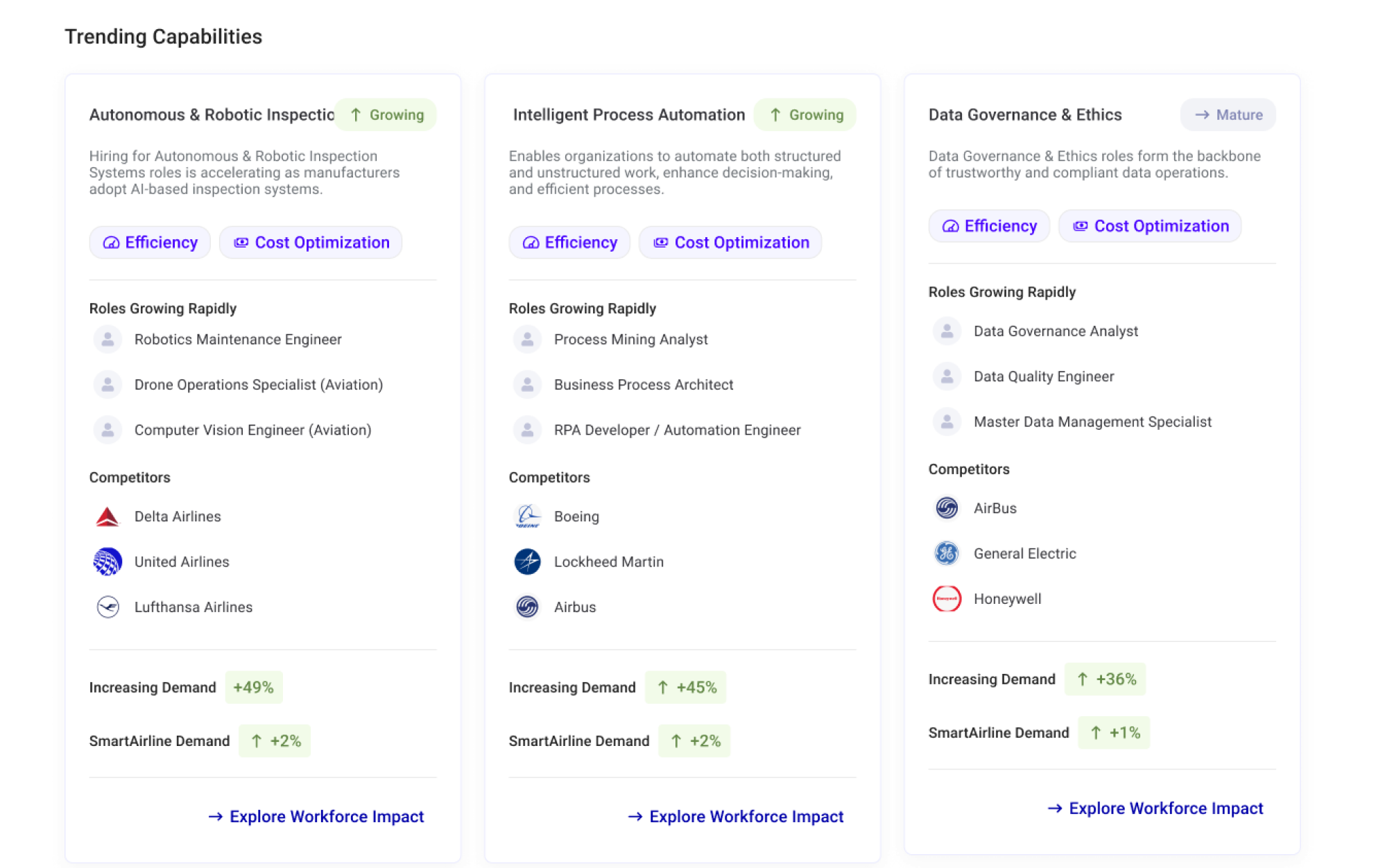
Expert Judgment × AI Amplification
The role of AI:
AI does not generate strategy from scratch.
It operates on structured logic defined by the capability layer.
It acts as an orchestration layer that:
- Identifies the most relevant signals
- Connects related insights across domains
- Assembles outputs into decision-ready views
This system turns strategy from something interpreted by experts into something users can explore and act on directly within the product.
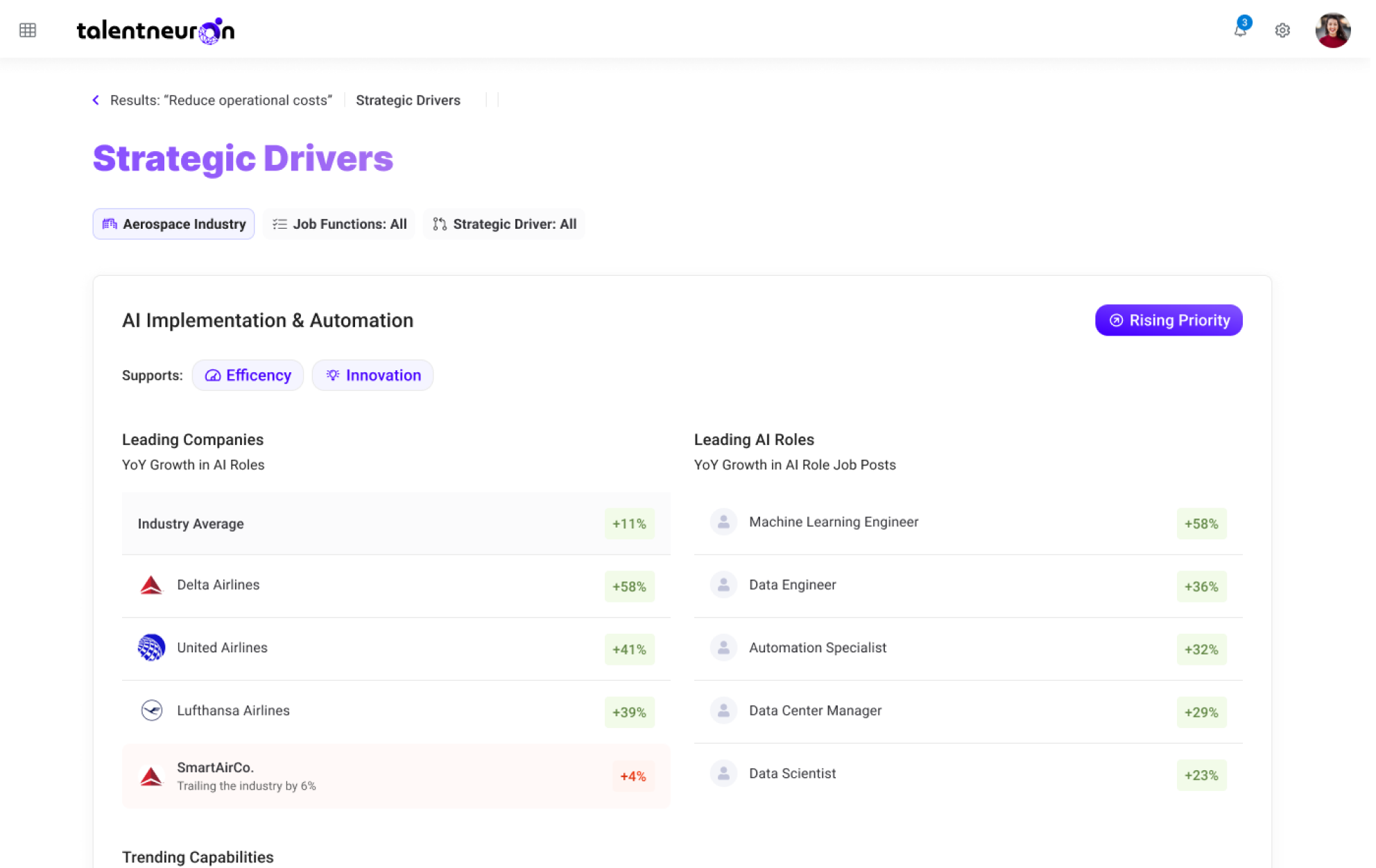
- Strategic drivers = decision lens
- Not dashboards → decision context
This system turned strategy from something interpreted by experts into something generated by the product.
Product Impact
This work repositioned the product from a data provider to a decision-support system.
By shifting the product from insight delivery to decision enablement, we fundamentally changed how it creates value for users and the business.
Previously, the platform was used as a reference tool, something users consulted for data, but relied on external workflows to act on it.
After this transformation, the product became a core part of the decision-making process.
What Changed
• From a data provider → to a decision-support system
• From a passive tool → to an active strategic partner
• From modular insights → to integrated workflows
Why It Matters
- Strategy is now created within the product, not outside of it
- Users can explore options and evaluate tradeoffs in real time
- Early-stage decision-making no longer depends on analyst availability
Foundation for Growth
- Enables AI-driven personalization based on user intent
- Scales strategy workflows across roles, regions, and use cases
- Expands into broader workforce planning and transformation scenarios
Internally, this work aligned product, UX, and data science around a clearer direction, moving away from incremental feature development toward building a system that delivers measurable strategic value.
The product no longer delivers information. It generates decisions.
Reflection
This work reinforced that data alone does not create value, decisions do.
Data doesn’t create value. Decisions do.
The biggest shift in this project wasn’t the data, it was how strategy was structured and applied.
For years, the focus had been on expanding access to insights. But more data only increases the burden of interpretation.
Value is created when users can confidently decide what to do next.
Ultimately, the opportunity isn’t just to build better tools.
It’s to build systems that make decision-making scalable.
© 2026 Daniel Merino
Product & Ux Strategy
Making Workforce Strategy Computable with AI
I designed a structured AI system that transformed labor market data into decision-ready strategy, reducing reliance on analysts and compressing workflows from weeks to minutes.
Built a structured strategy layer that turned workforce data into decision-ready recommendations.
Designed a structured AI system to translate data into strategy
Replaced analyst-dependent workflows with scalable AI guidance
Constrained AI outputs to ensure reliability and trust
Repositioned the product from insight delivery to decision support (Aligning with overall business strategy)
Traditional labor market platforms help users understand what’s happening.
They break when users need to decide what to do next.
At TalentNeuron, customers relied on the platform for data but depended on analysts and offline workflows to build strategy.
I led the transformation of the Market Intelligence platform into a system that generates strategic decisions through an AI-powered capability layer.
the real problem
Reducing Dependency, Enabling Strategy in the System
The problem wasn’t expert analysts. It was the absence of a system that could generate strategy without them.
The platform provided strong labor market insights.
But every strategic decision still required interpretation outside the product.
Across customer conversations and internal workflows, we saw a consistent pattern:
Users explored data but stopped short of action
Strategic decisions were taken offline
Analysts became a required step in the process
What This Meant
Strategy required offline workflows
Exploration was limited by time, cost, and analyst availability
Users couldn’t evaluate multiple strategic paths independently
“We use the platform for data, but strategy still happens in PowerPoint.”
Reframing the Problem
We initially approached this as an automation problem. But that wasn’t the right framing.
The goal wasn’t to replace experts.It was to make strategy possible within the system itself.
AI Constraint
This also exposed a critical limitation for AI.
Without a structured system connecting data to decisions:
• AI outputs would be inconsistent
• Recommendations would lack context
• Trust would break down quickly
AI couldn’t generate reliable strategy without a governed foundation.
What Needed to Change
To enable strategy within the product, the system needed to:
• Enable users to explore multiple strategic options independently
• Translate insights into decisions through structured system logic
• Support decision-making before expert engagement
Strategy wasn’t missing. It was unstructured, and therefore couldn’t exist in the system.
Journey Map created to follow the user’s workflow and identify opportunity
Shifting the Product’s Role
Making Strategy Computable
I transformed a labor market intelligence platform into a system that generates strategic decisions, not just insights.
The platform already provided strong insights across labor market data. But without a structured capability layer, there was no consistent way to translate those insights into strategic action.
Through product reviews and user conversations, we saw the same pattern:
- Users could identify trends
- But they couldn’t confidently decide what to do next
- Strategy depended on expert interpretation, not system support
“We still need to take this offline and figure out what it means.”
Key Insight
We realized the problem wasn’t insight quality.
It was the absence of a system that connects data to decisions.
Without that:
• Insights remained disconnected from action
• Strategy lived outside the product
• AI had no structured layer to operate on
New Concept
To solve this, I introduced a structured capability layer:
A system-level framework that:
- Maps signals to strategic capabilities
- Translates data into decision pathways
- Provides a foundation for AI to operate reliably
This shifted strategy from:
- something interpreted externally
- to something generated within the system
Product Role Transformation
Before: No Capability Layer
Insights disconnected from action
Strategy required expert interpretation
No consistent mapping from signals to decisions
AI lacked structure and produced inconsistent outputs
After: Capability Layer Introduced
Insights mapped to strategic capabilities
Strategy generated within the product
Consistent translation from signals to decisions
AI operates on structured, governed logic
Strategy didn’t become faster. It became computable.
new product direction
Reframing the Product
I shifted the product from delivering insights to making strategy possible within the system.
The product delivered strong labor market data, but it had no way to represent strategy. As a result, users were expected to interpret insights and construct decisions themselves.
I challenged this direction and reframed the problem:
Instead of asking:
“What insights should we show?”
We aligned around a different question:
“How can strategy be structured so the system can generate it?”
This shift led to a new product model:
• Strategy is not something users assemble manually
• It must be structured so it can exist within the system
• Insights alone are not enough without a layer that connects them to decisions
To support this, I aligned product, UX, and data science around a shared goal:
Turning labor market data into structured, decision-ready strategy
This reframing changed how we approached:
• Feature prioritization → Focus on decision-making, not data display
• System design → Introduce a capability layer to connect signals to actions
• AI’s role → Operate on structured strategy, not raw insights
This was the turning point: strategy could not scale until it became structured and representable.
how it works
The Strategy Model
The system turns market signals into strategy by structuring them into strategic drivers and capabilities.
To make this possible, I introduced a taxonomy, developed in collaboration with internal advisors and analysts, to ensure the system reflects real-world expertise.
• Strategic Drivers represent high-level business objectives
• Capabilities represent the actionable areas that support those objectives
Together, they define how strategy exists within the product.
Instead of generating answers from raw data, the system operates on this expert-informed framework.
Market signals across roles, skills, locations, and competitors are mapped to capabilities, grouped under strategic drivers, and assembled into decision-ready outputs.
Each output is grounded in curated expertise, not just data.
AI does not create strategy. It operates on it.
The capability layer encodes expert logic. AI orchestrates it.
Before, strategy had to be interpreted by experts.
Now, expert thinking is embedded into the system.
This system doesn’t replace experts. It scales their thinking.
the system
Making Strategy Computable
I introduced a capability layer that made strategy representable, and therefore generatable, within the product.
This layer sits between raw data and the user experience, structuring signals into strategic capabilities the system can interpret, connect, and act on.
Without it, strategy could not exist in the system. With it, strategy becomes computable.
How it worksThis layer sits between raw data and the user experience, structuring signals into strategic capabilities the system can interpret, connect, and act on.
Instead, the system guides them through a structured decision flow:
- Start with a business goal or hiring objective
- Provide context (role, job description, location preferences)
- Explore structured strategic pathways tied to that goal
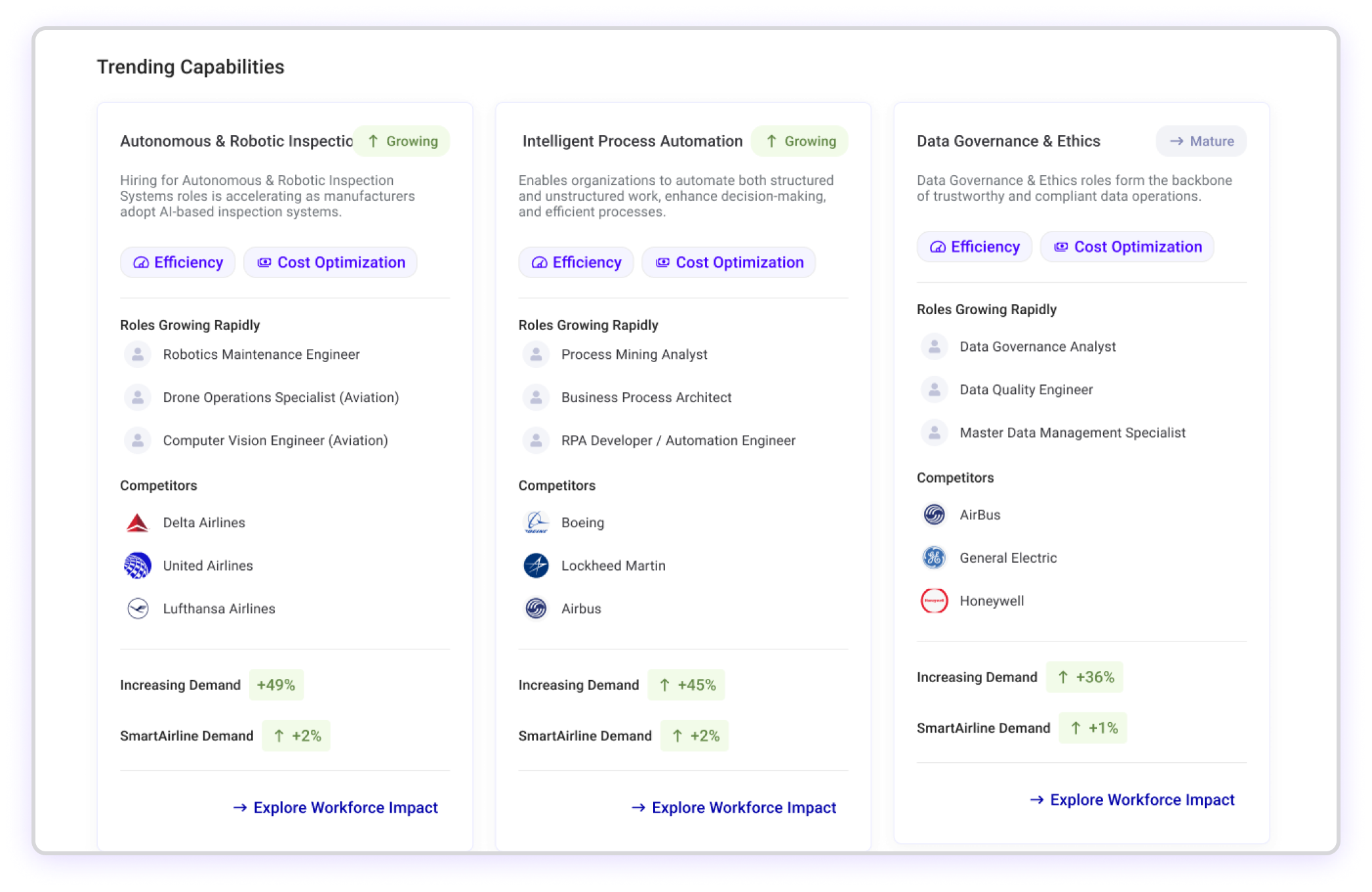
The system translates intent into relevant capabilities, giving users a clear starting point for decision-making.
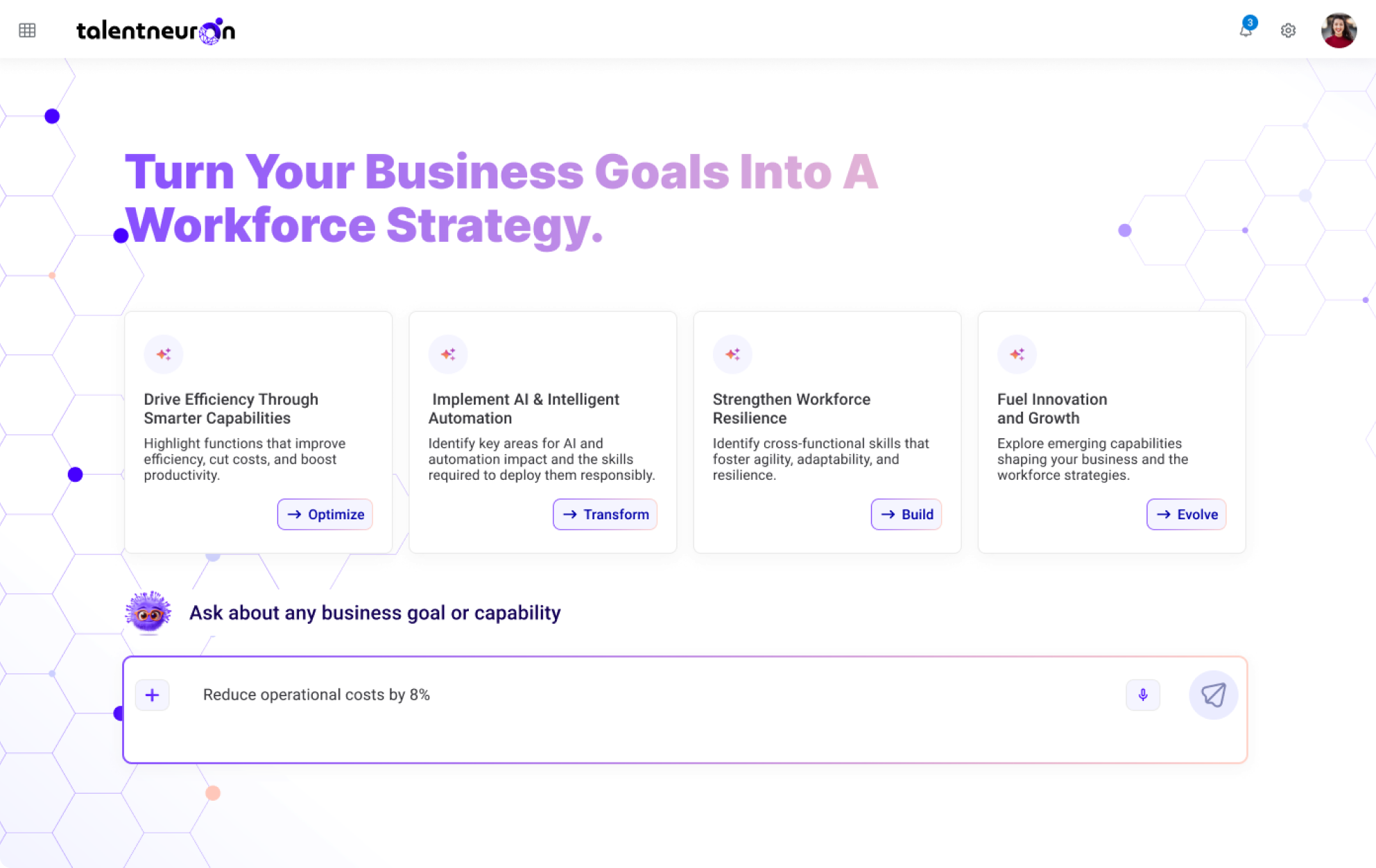
Capability cards = entry points into structured strategy
From Insight to Decision Context
Instead of analyzing disconnected data points like:
• Which companies are investing
• What roles are growing
• What tradeoffs exist
Capabilities act as the organizing layer:
• Connecting signals across roles, skills, locations, and competitors
• Framing insights around business objectives
• Surfacing tradeoffs in a comparable, structured way
Instead of interpreting raw data, users receive decision-ready views grounded in strategic context.
Expert Judgment × AI Amplification
The role of AI:
AI does not generate strategy from scratch.
It operates on structured logic defined by the capability layer.
It acts as an orchestration layer that:
- Identifies the most relevant signals
- Connects related insights across domains
- Assembles outputs into decision-ready views
This system turns strategy from something interpreted by experts into something users can explore and act on directly within the product.
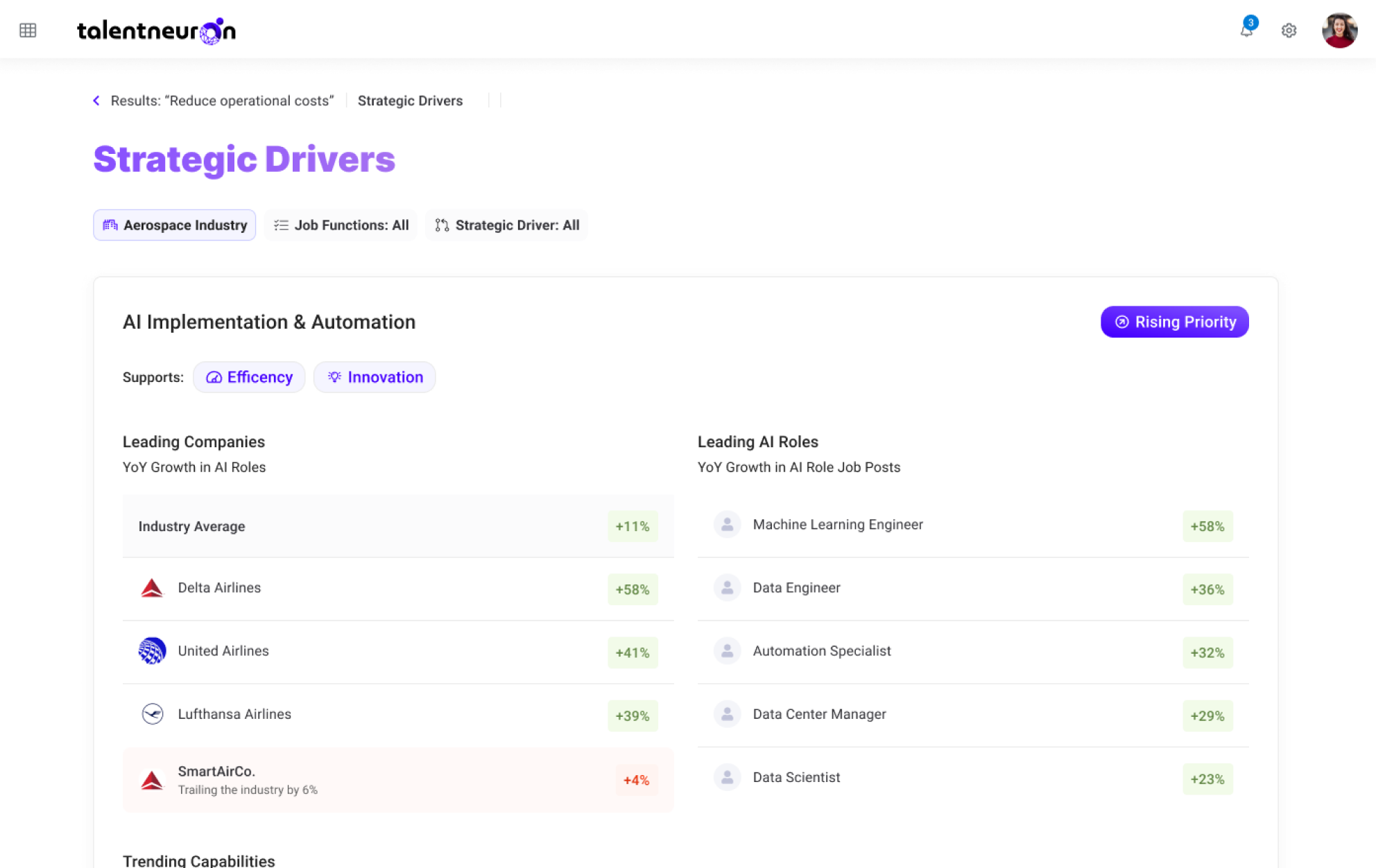
- Strategic drivers = decision lens
- Not dashboards → decision context
This system turned strategy from something interpreted by experts into something generated by the product.
Product Impact
This work repositioned the product from a data provider to a decision-support system.
By shifting the product from insight delivery to decision enablement, we fundamentally changed how it creates value for users and the business.
Previously, the platform was used as a reference tool, something users consulted for data, but relied on external workflows to act on it.
After this transformation, the product became a core part of the decision-making process.
What Changed
• From a data provider → to a decision-support system
• From a passive tool → to an active strategic partner
• From modular insights → to integrated workflows
Why It Matters
- Strategy is now created within the product, not outside of it
- Users can explore options and evaluate tradeoffs in real time
- Early-stage decision-making no longer depends on analyst availability
Foundation for Growth
- Enables AI-driven personalization based on user intent
- Scales strategy workflows across roles, regions, and use cases
- Expands into broader workforce planning and transformation scenarios
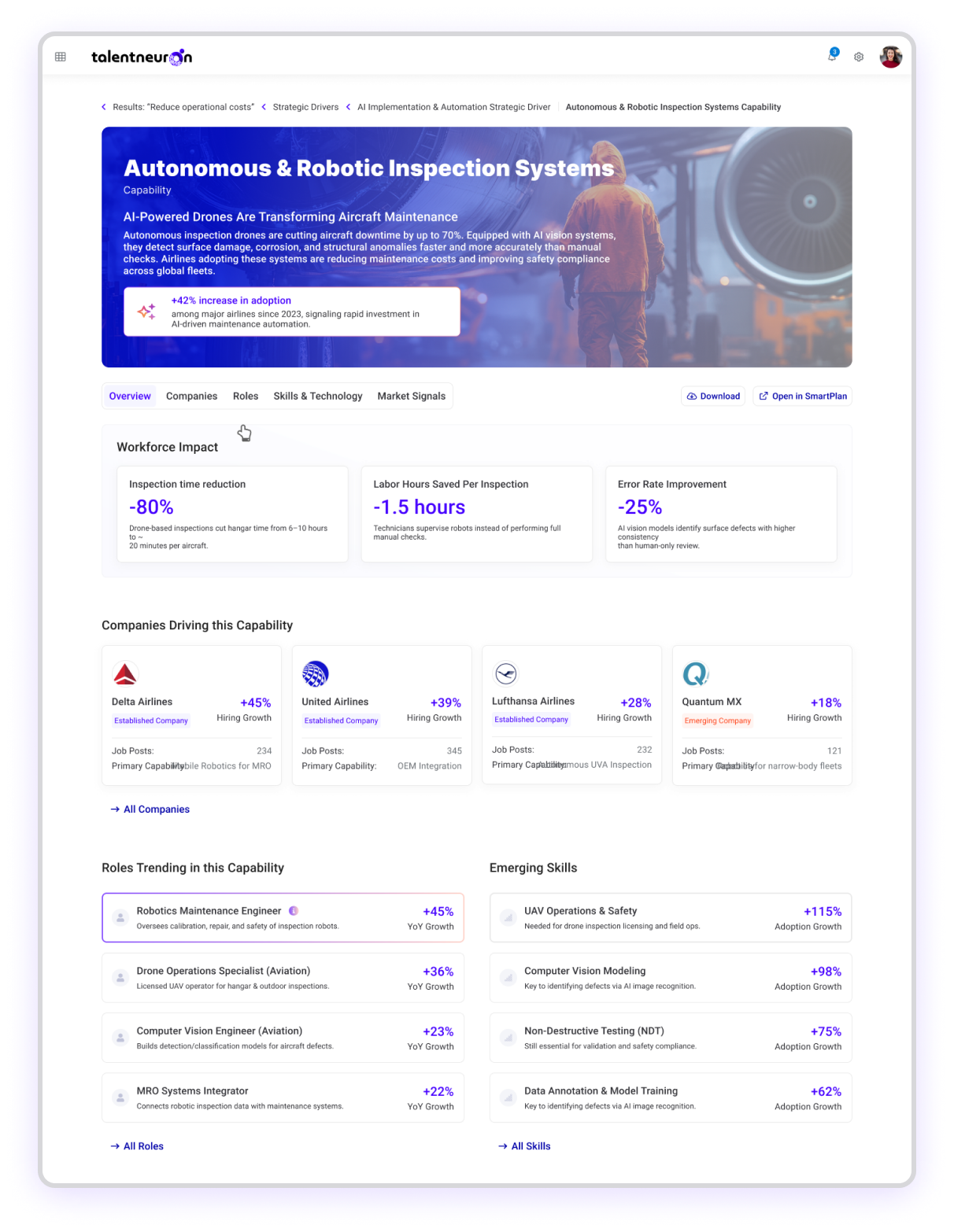
Internally, this work aligned product, UX, and data science around a clearer direction, moving away from incremental feature development toward building a system that delivers measurable strategic value.
The product no longer delivers information. It generates decisions.
Reflection
This work reinforced that data alone does not create value, decisions do.
Data doesn’t create value. Decisions do.
The biggest shift in this project wasn’t the data, it was how strategy was structured and applied.
For years, the focus had been on expanding access to insights. But more data only increases the burden of interpretation.
Value is created when users can confidently decide what to do next.
Ultimately, the opportunity isn’t just to build better tools.
It’s to build systems that make decision-making scalable.
© 2026 Daniel Merino
Product & Ux Strategy