
Transforming a Legacy Analytics Platform with AI-Driven Product Strategy
How I used agentic AI to migrate a legacy analytics platform into a unified MVP, without rebuilding it.
Thousands of users depended on a platform the business had decided to move beyond. We couldn't rebuild it. We couldn't ignore it. The question wasn't what to design, it was what to preserve, what to cut, and how to make that call with confidence under real constraints.
I led product and UX strategy to answer that. This is how.
Migrate Without Rebuilding
The business had made its decision: investment was shifting to a new platform. But thousands of users still depended on the legacy system, and we couldn't just walk away from them.
The constraints were real:
- New tech stack rebuild
- No replication of six legacy modules
- Minimize operational footprint of SaaS product
- No duplicated workflows
- And no slowing the broader strategic shift.
Most teams would have treated this as a design problem. It wasn't. It was a judgment problem. What is the minimum system that preserves user value, reduces friction, and enables migration, without over-investing in a platform the business is moving beyond?
That question became the brief. I owned the answer.
AI-Augmented Discovery

Expert Judgment × AI Amplification
Before defining the MVP, I needed clarity on three things:
- What users were actually struggling with
- What leadership expected the platform to become
- Whether those aligned with real market signals
Traditional research would have taken months.
I built an agentic discovery system instead.
It synthesized signals across:
• User Research
• Customer Conversations
• Operational Data
• Market Intelligence
AI surfaced patterns across years of data, compressing months of discovery into days and increasing confidence in product decisions.
AI didn’t make the decisions. It made the decisions clear.
Agentic AI Discovery Engine
AI-accelerated discovery turned months of research into days, enabling faster, higher-confidence product decisions.


SOURCES

Market Research
Consulting and academic

Dovetail
Legacy feedback

Gong
Customer calls
Salesforce
Account signals

Jira
Tickets and bugs
Chief Product Officer Strategy
Talks, notes, docs
Sharepoint sites / Notes
Strategy outlines
Accessibility Rules
WCAG, internal standards


AI Synthesis Agents
Voice of the Customer Agent
Dovetail feedback signals
Legacy Persona Research
Gong customer calls
Salesforce account data
Jira Ticket Agent
Cross reference open tickets to strategic initiative.
Strategy Agent
Distills CPO strategy inputs
Market Research Agent
Aggregates research evidence
Literature Reviews as Artifacts
Design Agent
Applies usability heuristics to product design
Validates design system against WCAG rules
Design System Semantics (Tokens)


Human Judgement and expertise


DECISION ARTIFACTS
Persistent Pain Signals
SWP User Journey Map
Use Case Library
(normalized)
Strategy Principles & Constraints
Market Validation Summary
Consolidation Opportunities
MVP Scope Proposal
Risks & Tradeoffs
Information Architecture & Labeling System
High Fidelity Prototypes


PRODUCT STRATEGY
OUTCOMES
Six Month Roadmap
MVP Scope Locked
Flat Navigation Direction
Global Filter Model
Module Consolidation Plan
AI Insight Layer Concept
AI Search & Dashboard Generation Concept
Synthesizing these signals revealed a structural pattern in the legacy platform that fundamentally changed the MVP strategy.
The Structural Insight
When I synthesized signals across research, customer conversations, and operational data, a clear pattern emerged:
Users weren’t trying to use six different modules. They were trying to complete a single task.
But the platform forced them to move across multiple tools to get there.
What should have been one workflow was fragmented across independent modules, each solving a piece of the same problem. Great for sales, not so much for the user.
The issue wasn’t missing features. It was how the system was structured.
This created an opportunity:
Instead of rebuilding every module, we could simplify the experience, focusing on navigation and aligning with the company’s strategy to reduce the platform’s footprint.
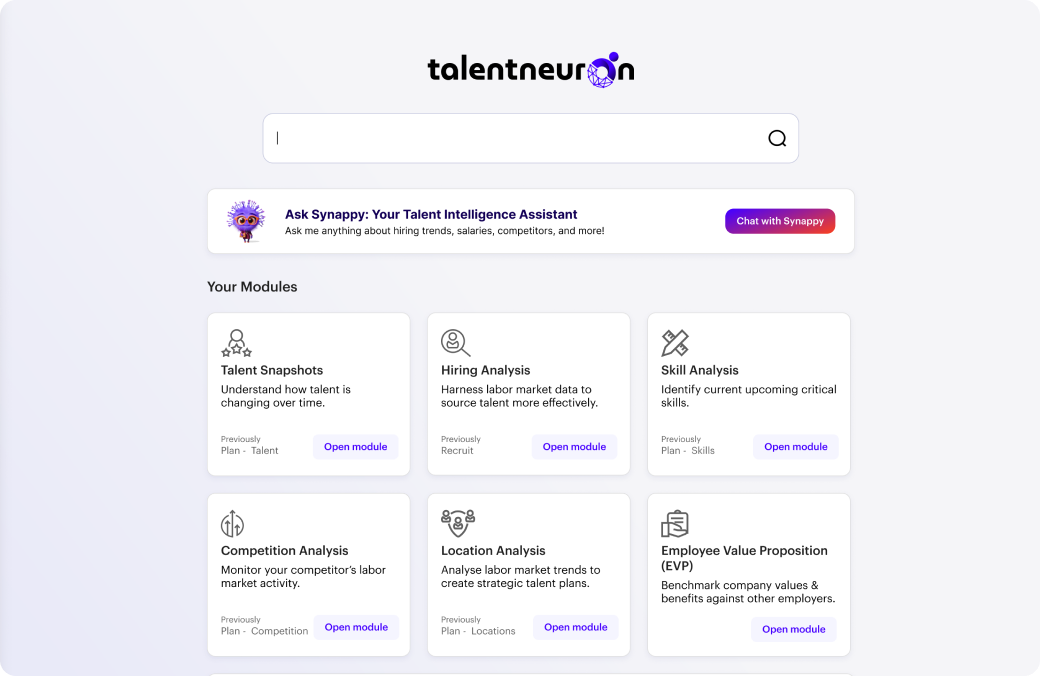
Legacy: 6 Independent Modules
The TalentNeuron legacy platform was structured around six separate modules. Each module was designed to address specific workforce planning use cases, operating largely independently from one another.
New Platform Architecture
Instead of making users move across multiple modules, we designed a single place to answer their questions.
The platform became a unified experience, where users could explore insights without switching tools or piecing information together.
At the core, we connected the same key elements that existed across every module:
roles, skills, locations, employers, and market signals.
Instead of duplicating them in separate tools, we brought them together, so the system could generate insights dynamically based on what the user needed.
This allowed users to:
Explore role insights
Compare Locations
Explore role insights
Plan their workforce
all in one place.
The product shifted from a collection of tools to a single, connected experience.
The result: a platform designed around decisions, not features.
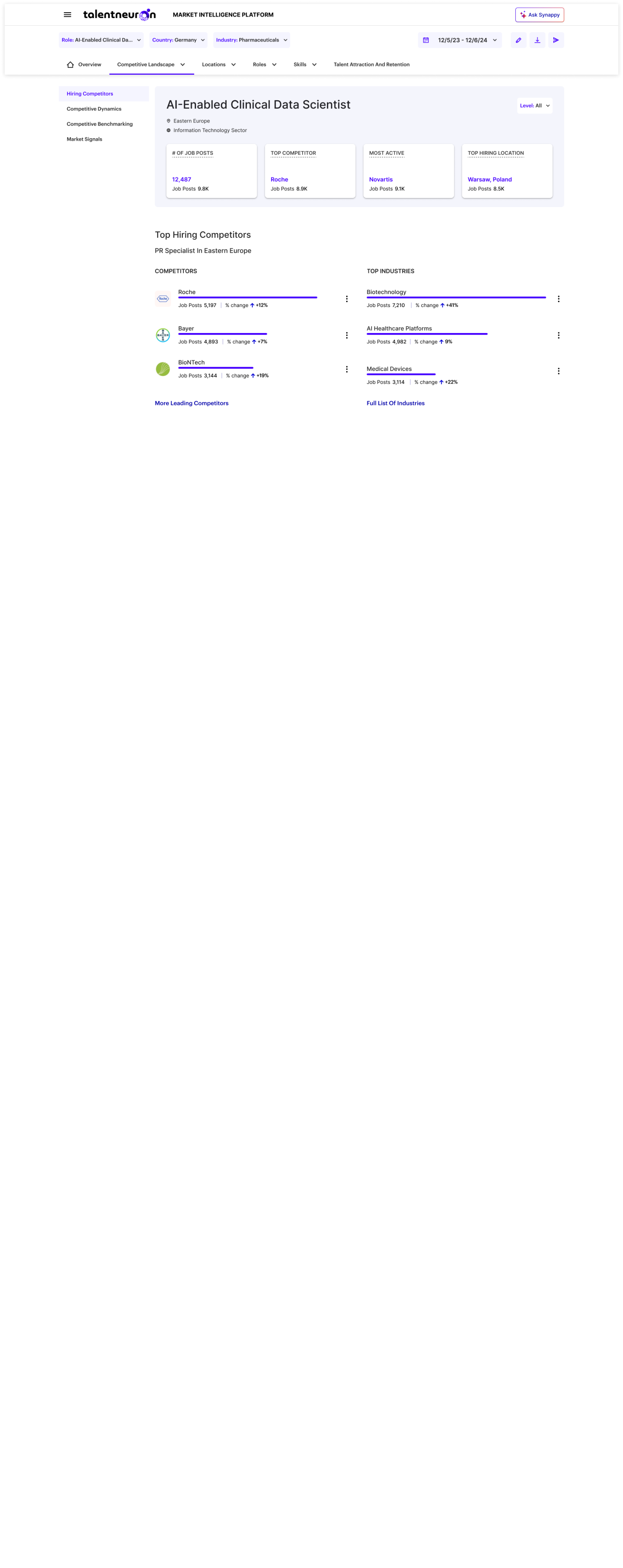
Fragmented experience with six different modules
AI-Enabled Intelligence Layer
While the unified architecture simplified the platform structurally, AI was introduced to fundamentally improve how users interact with labor market data.
Rather than generating new information, the AI layer was designed to orchestrate insights from the platform’s governed data lake.
This distinction was critical. Every insight surfaced by the system remained grounded in verified platform data.
Three capabilities enabled this experience.
- AI Smart Search allows users to ask workforce questions directly. The system interprets the intent of the query, applies relevant filters, and generates an analytical view using trusted data from the platform.
- AI-Assembled Dashboards dynamically surface the most relevant charts and signals based on the user’s question, eliminating the need to navigate across multiple tools.
- AI Personalized Insight Layer provides contextual interpretation of the data, helping users understand what signals matter for their specific workforce planning task.
Together, these capabilities transform the platform from a static analytics tool into an adaptive intelligence system capable of guiding workforce decisions.
Defining the MVP
With the new architecture established, the next step was determining what capabilities needed to exist in the first version of the platform.
The goal was not to recreate the legacy system.
The goal was to preserve the core analytical value required for users to successfully migrate to the new platform.
Using the consolidated use case library generated during discovery, I evaluated which capabilities were essential for supporting the most common workforce intelligence workflows.
The resulting MVP preserved approximately 60% of legacy use cases, focusing on the analyses that users relied on most frequently.
Several key design principles guided these decisions.
Eliminating Insight Duplication
One of the biggest issues in the legacy platform was duplicated insights appearing across multiple modules. Location analysis was a clear example, with variations of similar widgets spread across four different modules.
Although the data was accurate, users often had to search across modules to find the specific version of the insight they remembered. This created unnecessary cognitive load and navigation confusion.
To address this, the new platform established a simple rule: each insight has a single authoritative location in the system.
Insights are now organized around the entities they describe, such as roles, locations, employers, and skills, rather than the modules that originally contained them.
Strategic Scope Discipline
Capabilities that required significant engineering investment or aligned more closely with the company’s future Strategic Workforce Planning roadmap were intentionally excluded from the MVP and documented for future initiatives.
The result was a streamlined platform capable of supporting the majority of real user workflows while remaining aligned with the company’s broader strategic priorities.
Outcome and Product Impact
The final deliverable was a high-fidelity prototype of the Market Intelligence MVP designed to enable a smooth transition from the legacy platform.
The new system preserved approximately 60% of legacy use cases, focusing on the analyses users relied on most frequently while removing structural complexity that had accumulated over time.
By consolidating duplicated workflows and organizing insights around shared labor market entities, the platform significantly simplified how users navigate and explore workforce intelligence.
The introduction of AI Smart Search and AI-assembled dashboards further improved usability by allowing users to generate relevant analyses directly from their questions rather than navigating across modules.
Most importantly, the solution aligned with the company’s broader strategic direction.
It provided a streamlined migration path for existing users while allowing the organization to focus its primary investment on the emerging Strategic Workforce Planning platform.
This project demonstrated how AI-enabled product strategy can accelerate discovery, strengthen product decisions, and enable confident platform transformation.
© 2026 Daniel Merino
Product & Ux Strategy
Transforming a Legacy Analytics Platform with AI-Driven Product Strategy
How I used agentic AI to migrate a legacy analytics platform into a unified MVP, without rebuilding it.
Thousands of users depended on a platform the business had decided to move beyond. We couldn't rebuild it. We couldn't ignore it. The question wasn't what to design, it was what to preserve, what to cut, and how to make that call with confidence under real constraints.
I led product and UX strategy to answer that. This is how.
Migrate Without Rebuilding
The business had made its decision: investment was shifting to a new platform. But thousands of users still depended on the legacy system, and we couldn't just walk away from them.
The constraints were real:
- New tech stack rebuild
- No replication of six legacy modules
- Minimize operational footprint of SaaS product
- No duplicated workflows
- And no slowing the broader strategic shift.
Most teams would have treated this as a design problem. It wasn't. It was a judgment problem. What is the minimum system that preserves user value, reduces friction, and enables migration, without over-investing in a platform the business is moving beyond?
That question became the brief. I owned the answer.
AI-Augmented Discovery

Expert Judgment × AI Amplification
Before defining the MVP, I needed clarity on three things:
- What users were actually struggling with
- What leadership expected the platform to become
- Whether those aligned with real market signals
Traditional research would have taken months.
I built an agentic discovery system instead.
It synthesized signals across:
• User Research
• Customer Conversations
• Operational Data
• Market Intelligence
AI surfaced patterns across years of data, compressing months of discovery into days and increasing confidence in product decisions.
AI didn’t make the decisions. It made the decisions clear.
Agentic AI Discovery Engine
AI-accelerated discovery turned months of research into days, enabling faster, higher-confidence product decisions.
SOURCES
Market Research
Consulting and academic
Dovetail
Legacy feedback
Gong
Customer calls
Salesforce
Account signals
Jira
Tickets and bugs
Chief Product Officer Strategy
Talks, notes, docs
Sharepoint sites / Notes
Strategy outlines
Accessibility Rules
WCAG, internal standards

AI Synthesis Agents
Voice of the Customer Agent
Dovetail feedback signals
Legacy Persona Research
Gong customer calls
Salesforce account data
Jira Ticket Agent
Cross reference open tickets to strategic initiative.
Strategy Agent
Distills CPO strategy inputs
Market Research Agent
Aggregates research evidence
Literature Reviews as Artifacts
Design Agent
Applies usability heuristics to product design
Validates design system against WCAG rules
Design System Semantics (Tokens)
Human Judgement and expertise
DECISION ARTIFACTS
Persistent Pain Signals
SWP User Journey Map
Use Case Library
(normalized)
Strategy Principles & Constraints
Market Validation Summary
Consolidation Opportunities
MVP Scope Proposal
Risks & Tradeoffs
Information Architecture & Labeling System
High Fidelity Prototypes
PRODUCT STRATEGY
OUTCOMES
Six Month Roadmap
MVP Scope Locked
Flat Navigation Direction
Global Filter Model
Module Consolidation Plan
AI Insight Layer Concept
AI Search & Dashboard Generation Concept
Synthesizing these signals revealed a structural pattern in the legacy platform that fundamentally changed the MVP strategy.
The Structural Insight
When I synthesized signals across research, customer conversations, and operational data, a clear pattern emerged:
Users weren’t trying to use six different modules. They were trying to complete a single task.
But the platform forced them to move across multiple tools to get there.
What should have been one workflow was fragmented across independent modules, each solving a piece of the same problem. Great for sales, not so much for the user.
The issue wasn’t missing features. It was how the system was structured.
This created an opportunity:
Instead of rebuilding every module, we could simplify the experience, focusing on navigation and aligning with the company’s strategy to reduce the platform’s footprint.
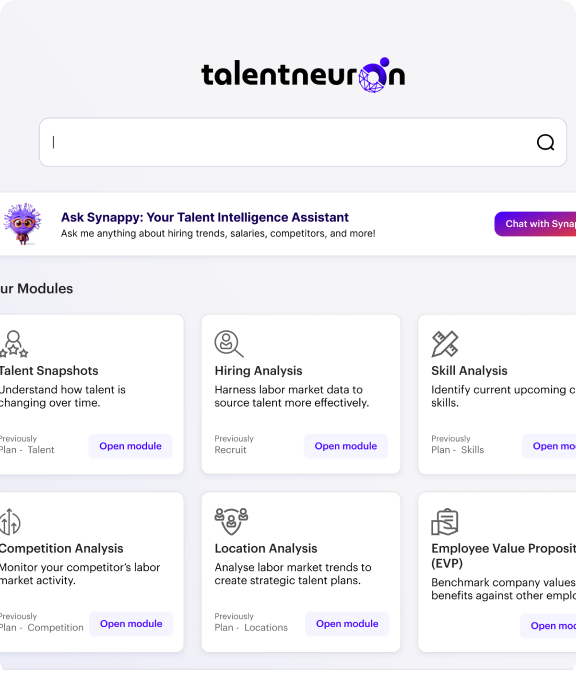
Legacy: 6 Independent Modules
The TalentNeuron legacy platform was structured around six separate modules. Each module was designed to address specific workforce planning use cases, operating largely independently from one another.
New Platform Architecture
Instead of making users move across multiple modules, we designed a single place to answer their questions.
The platform became a unified experience, where users could explore insights without switching tools or piecing information together.
At the core, we connected the same key elements that existed across every module:
roles, skills, locations, employers, and market signals.
Instead of duplicating them in separate tools, we brought them together, so the system could generate insights dynamically based on what the user needed.
This allowed users to:
Explore role insights
Compare Locations
Explore role insights
Plan their workforce
all in one place.
The product shifted from a collection of tools to a single, connected experience.
The result: a platform designed around decisions, not features.
Fragmented experience with six different modules
AI-Enabled Intelligence Layer
While the unified architecture simplified the platform structurally, AI was introduced to fundamentally improve how users interact with labor market data.
Rather than generating new information, the AI layer was designed to orchestrate insights from the platform’s governed data lake.
This distinction was critical. Every insight surfaced by the system remained grounded in verified platform data.
Three capabilities enabled this experience.
- AI Smart Search allows users to ask workforce questions directly. The system interprets the intent of the query, applies relevant filters, and generates an analytical view using trusted data from the platform.
- AI-Assembled Dashboards dynamically surface the most relevant charts and signals based on the user’s question, eliminating the need to navigate across multiple tools.
- AI Personalized Insight Layer provides contextual interpretation of the data, helping users understand what signals matter for their specific workforce planning task.
Together, these capabilities transform the platform from a static analytics tool into an adaptive intelligence system capable of guiding workforce decisions.
Defining the MVP
With the new architecture established, the next step was determining what capabilities needed to exist in the first version of the platform.
The goal was not to recreate the legacy system.
The goal was to preserve the core analytical value required for users to successfully migrate to the new platform.
Using the consolidated use case library generated during discovery, I evaluated which capabilities were essential for supporting the most common workforce intelligence workflows.
The resulting MVP preserved approximately 60% of legacy use cases, focusing on the analyses that users relied on most frequently.
Several key design principles guided these decisions.
Eliminating Insight Duplication
One of the biggest issues in the legacy platform was duplicated insights appearing across multiple modules. Location analysis was a clear example, with variations of similar widgets spread across four different modules.
Although the data was accurate, users often had to search across modules to find the specific version of the insight they remembered. This created unnecessary cognitive load and navigation confusion.
To address this, the new platform established a simple rule: each insight has a single authoritative location in the system.
Insights are now organized around the entities they describe, such as roles, locations, employers, and skills, rather than the modules that originally contained them.
Strategic Scope Discipline
Capabilities that required significant engineering investment or aligned more closely with the company’s future Strategic Workforce Planning roadmap were intentionally excluded from the MVP and documented for future initiatives.
The result was a streamlined platform capable of supporting the majority of real user workflows while remaining aligned with the company’s broader strategic priorities.
Outcome and Product Impact
The final deliverable was a high-fidelity prototype of the Market Intelligence MVP designed to enable a smooth transition from the legacy platform.
The new system preserved approximately 60% of legacy use cases, focusing on the analyses users relied on most frequently while removing structural complexity that had accumulated over time.
By consolidating duplicated workflows and organizing insights around shared labor market entities, the platform significantly simplified how users navigate and explore workforce intelligence.
The introduction of AI Smart Search and AI-assembled dashboards further improved usability by allowing users to generate relevant analyses directly from their questions rather than navigating across modules.
Most importantly, the solution aligned with the company’s broader strategic direction.
It provided a streamlined migration path for existing users while allowing the organization to focus its primary investment on the emerging Strategic Workforce Planning platform.
This project demonstrated how AI-enabled product strategy can accelerate discovery, strengthen product decisions, and enable confident platform transformation.
© 2026 Daniel Merino
Product & Ux Strategy
Transforming a Legacy Analytics Platform with AI-Driven Product Strategy
How I used agentic AI to migrate a legacy analytics platform into a unified MVP, without rebuilding it.
Thousands of users depended on a platform the business had decided to move beyond. We couldn't rebuild it. We couldn't ignore it. The question wasn't what to design, it was what to preserve, what to cut, and how to make that call with confidence under real constraints.
I led product and UX strategy to answer that. This is how.
Migrate Without Rebuilding
The business had made its decision: investment was shifting to a new platform. But thousands of users still depended on the legacy system, and we couldn't just walk away from them.
The constraints were real:
- New tech stack rebuild
- No replication of six legacy modules
- Minimize operational footprint of SaaS product
- No duplicated workflows
- And no slowing the broader strategic shift.
Most teams would have treated this as a design problem. It wasn't. It was a judgment problem. What is the minimum system that preserves user value, reduces friction, and enables migration, without over-investing in a platform the business is moving beyond?
That question became the brief. I owned the answer.
AI-Augmented Discovery
Expert Judgment × AI Amplification
Before defining the MVP, I needed clarity on three things:
- What users were actually struggling with
- What leadership expected the platform to become
- Whether those aligned with real market signals
Traditional research would have taken months.
I built an agentic discovery system instead.
It synthesized signals across:
• User Research
• Customer Conversations
• Operational Data
• Market Intelligence
AI surfaced patterns across years of data, compressing months of discovery into days and increasing confidence in product decisions.
AI didn’t make the decisions. It made the decisions clear.
Agentic AI Discovery Engine
AI-accelerated discovery turned months of research into days, enabling faster, higher-confidence product decisions.
SOURCES
Market Research
Consulting and academic
Dovetail
Legacy feedback
Gong
Customer calls
Salesforce
Account signals
Jira
Tickets and bugs
Chief Product Officer Strategy
Talks, notes, docs
Sharepoint sites / Notes
Strategy outlines
Accessibility Rules
WCAG, internal standards
AI Synthesis Agents
Voice of the Customer Agent
Dovetail feedback signals
Legacy Persona Research
Gong customer calls
Salesforce account data
Jira Ticket Agent
Cross reference open tickets to strategic initiative.
Strategy Agent
Distills CPO strategy inputs
Market Research Agent
Aggregates research evidence
Literature Reviews as Artifacts
Design Agent
Applies usability heuristics to product design
Validates design system against WCAG rules
Design System Semantics (Tokens)
Human Judgement and expertise
DECISION ARTIFACTS
Persistent Pain Signals
SWP User Journey Map
Use Case Library
(normalized)
Strategy Principles & Constraints
Market Validation Summary
Consolidation Opportunities
MVP Scope Proposal
Risks & Tradeoffs
Information Architecture & Labeling System
High Fidelity Prototypes
PRODUCT STRATEGY OUTCOMES
Six Month Roadmap
MVP Scope Locked
Flat Navigation Direction
Global Filter Model
Module Consolidation Plan
AI Insight Layer Concept
AI Search & Dashboard Generation Concept
Synthesizing these signals revealed a structural pattern in the legacy platform that fundamentally changed the MVP strategy.
The Structural Insight
When I synthesized signals across research, customer conversations, and operational data, a clear pattern emerged:
Users weren’t trying to use six different modules. They were trying to complete a single task.
But the platform forced them to move across multiple tools to get there.
What should have been one workflow was fragmented across independent modules, each solving a piece of the same problem. Great for sales, not so much for the user.
The issue wasn’t missing features. It was how the system was structured.
This created an opportunity:
Instead of rebuilding every module, we could simplify the experience, focusing on navigation and aligning with the company’s strategy to reduce the platform’s footprint.
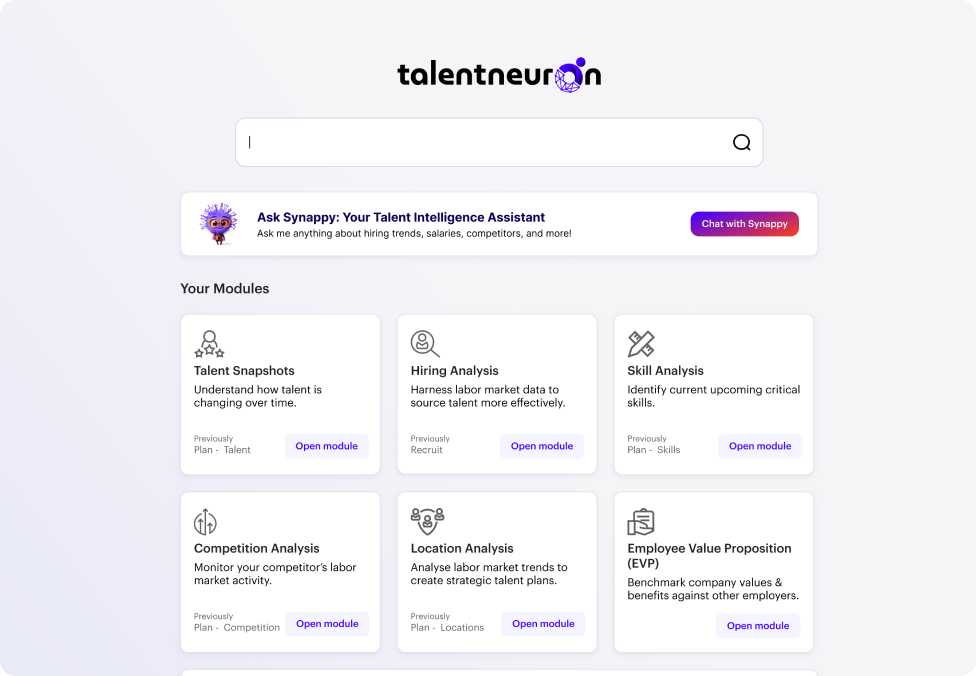
Legacy: 6 Independent Modules
The TalentNeuron legacy platform was structured around six separate modules. Each module was designed to address specific workforce planning use cases, operating largely independently from one another.
New Platform Architecture
Instead of making users move across multiple modules, we designed a single place to answer their questions.
The platform became a unified experience, where users could explore insights without switching tools or piecing information together.
At the core, we connected the same key elements that existed across every module:
roles, skills, locations, employers, and market signals.
Instead of duplicating them in separate tools, we brought them together, so the system could generate insights dynamically based on what the user needed.
This allowed users to:
Explore role insights
Compare Locations
Explore role insights
Plan their workforce
all in one place.
The product shifted from a collection of tools to a single, connected experience.
The result: a platform designed around decisions, not features.
Fragmented experience with six different modules
AI-Enabled Intelligence Layer
While the unified architecture simplified the platform structurally, AI was introduced to fundamentally improve how users interact with labor market data.
Rather than generating new information, the AI layer was designed to orchestrate insights from the platform’s governed data lake.
This distinction was critical. Every insight surfaced by the system remained grounded in verified platform data.
Three capabilities enabled this experience.
- AI Smart Search allows users to ask workforce questions directly. The system interprets the intent of the query, applies relevant filters, and generates an analytical view using trusted data from the platform.
- AI-Assembled Dashboards dynamically surface the most relevant charts and signals based on the user’s question, eliminating the need to navigate across multiple tools.
- AI Personalized Insight Layer provides contextual interpretation of the data, helping users understand what signals matter for their specific workforce planning task.
Together, these capabilities transform the platform from a static analytics tool into an adaptive intelligence system capable of guiding workforce decisions.
Defining the MVP
With the new architecture established, the next step was determining what capabilities needed to exist in the first version of the platform.
The goal was not to recreate the legacy system.
The goal was to preserve the core analytical value required for users to successfully migrate to the new platform.
Using the consolidated use case library generated during discovery, I evaluated which capabilities were essential for supporting the most common workforce intelligence workflows.
The resulting MVP preserved approximately 60% of legacy use cases, focusing on the analyses that users relied on most frequently.
Several key design principles guided these decisions.
Eliminating Insight Duplication
One of the biggest issues in the legacy platform was duplicated insights appearing across multiple modules. Location analysis was a clear example, with variations of similar widgets spread across four different modules.
Although the data was accurate, users often had to search across modules to find the specific version of the insight they remembered. This created unnecessary cognitive load and navigation confusion.
To address this, the new platform established a simple rule: each insight has a single authoritative location in the system.
Insights are now organized around the entities they describe, such as roles, locations, employers, and skills, rather than the modules that originally contained them.
Strategic Scope Discipline
Capabilities that required significant engineering investment or aligned more closely with the company’s future Strategic Workforce Planning roadmap were intentionally excluded from the MVP and documented for future initiatives.
The result was a streamlined platform capable of supporting the majority of real user workflows while remaining aligned with the company’s broader strategic priorities.
Outcome and Product Impact
The final deliverable was a high-fidelity prototype of the Market Intelligence MVP designed to enable a smooth transition from the legacy platform.
The new system preserved approximately 60% of legacy use cases, focusing on the analyses users relied on most frequently while removing structural complexity that had accumulated over time.
By consolidating duplicated workflows and organizing insights around shared labor market entities, the platform significantly simplified how users navigate and explore workforce intelligence.
The introduction of AI Smart Search and AI-assembled dashboards further improved usability by allowing users to generate relevant analyses directly from their questions rather than navigating across modules.
Most importantly, the solution aligned with the company’s broader strategic direction.
It provided a streamlined migration path for existing users while allowing the organization to focus its primary investment on the emerging Strategic Workforce Planning platform.
This project demonstrated how AI-enabled product strategy can accelerate discovery, strengthen product decisions, and enable confident platform transformation.
© 2026 Daniel Merino
Product & Ux Strategy
Transforming a Legacy Analytics Platform with AI-Driven Product Strategy
How I used agentic AI to migrate a legacy analytics platform into a unified MVP, without rebuilding it.
Thousands of users depended on a platform the business had decided to move beyond. We couldn't rebuild it. We couldn't ignore it. The question wasn't what to design, it was what to preserve, what to cut, and how to make that call with confidence under real constraints.
I led product and UX strategy to answer that. This is how.
Migrate Without Rebuilding
The business had made its decision: investment was shifting to a new platform. But thousands of users still depended on the legacy system, and we couldn't just walk away from them.
The constraints were real:
- New tech stack rebuild
- No replication of six legacy modules
- Minimize operational footprint of SaaS product
- No duplicated workflows
- And no slowing the broader strategic shift.
Most teams would have treated this as a design problem. It wasn't. It was a judgment problem. What is the minimum system that preserves user value, reduces friction, and enables migration, without over-investing in a platform the business is moving beyond?
That question became the brief. I owned the answer.
AI-Augmented Discovery

Expert Judgment × AI Amplification
Before defining the MVP, I needed clarity on three things:
- What users were actually struggling with
- What leadership expected the platform to become
- Whether those aligned with real market signals
Traditional research would have taken months.
I built an agentic discovery system instead.
It synthesized signals across:
• User Research
• Customer Conversations
• Operational Data
• Market Intelligence
AI surfaced patterns across years of data, compressing months of discovery into days and increasing confidence in product decisions.
AI didn’t make the decisions. It made the decisions clear.
Agentic AI Discovery Engine
AI-accelerated discovery turned months of research into days, enabling faster, higher-confidence product decisions.
SOURCES
Market Research
Consulting and academic
Dovetail
Legacy feedback
Gong
Customer calls
Salesforce
Account signals
Jira
Tickets and bugs
Chief Product Officer Strategy
Talks, notes, docs
Sharepoint sites / Notes
Strategy outlines
Accessibility Rules
WCAG, internal standards
AI Synthesis Agents
Voice of the Customer Agent
Dovetail feedback signals
Legacy Persona Research
Gong customer calls
Salesforce account data
Jira Ticket Agent
Cross reference open tickets to strategic initiative.
Strategy Agent
Distills CPO strategy inputs
Market Research Agent
Aggregates research evidence
Literature Reviews as Artifacts
Design Agent
Applies usability heuristics to product design
Validates design system against WCAG rules
Design System Semantics (Tokens)
Human Judgement and expertise
DECISION ARTIFACTS
Persistent Pain Signals
SWP User Journey Map
Use Case Library
(normalized)
Strategy Principles & Constraints
Market Validation Summary
Consolidation Opportunities
MVP Scope Proposal
Risks & Tradeoffs
Information Architecture & Labeling System
High Fidelity Prototypes
PRODUCT STRATEGY OUTCOMES
Six Month Roadmap
MVP Scope Locked
Flat Navigation Direction
Global Filter Model
Module Consolidation Plan
AI Insight Layer Concept
AI Search & Dashboard Generation Concept
Synthesizing these signals revealed a structural pattern in the legacy platform that fundamentally changed the MVP strategy.
The Structural Insight
When I synthesized signals across research, customer conversations, and operational data, a clear pattern emerged:
Users weren’t trying to use six different modules. They were trying to complete a single task.
But the platform forced them to move across multiple tools to get there.
What should have been one workflow was fragmented across independent modules, each solving a piece of the same problem. Great for sales, not so much for the user.
The issue wasn’t missing features. It was how the system was structured.
This created an opportunity:
Instead of rebuilding every module, we could simplify the experience, focusing on navigation and aligning with the company’s strategy to reduce the platform’s footprint.
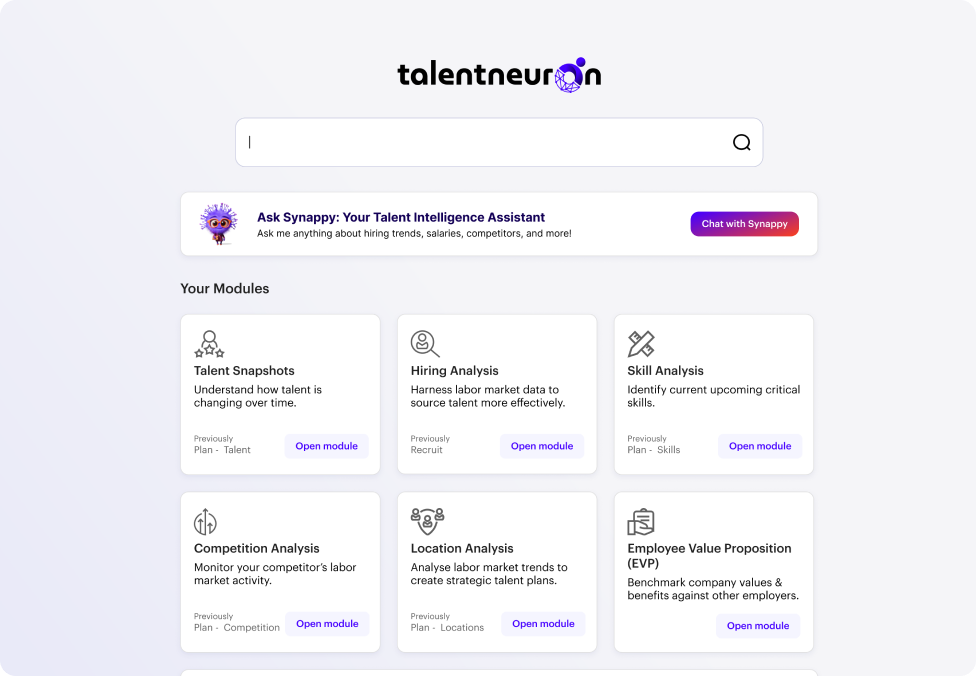
Legacy: 6 Independent Modules
The TalentNeuron legacy platform was structured around six separate modules. Each module was designed to address specific workforce planning use cases, operating largely independently from one another.
New Platform Architecture
Instead of making users move across multiple modules, we designed a single place to answer their questions.
The platform became a unified experience, where users could explore insights without switching tools or piecing information together.
At the core, we connected the same key elements that existed across every module:
roles, skills, locations, employers, and market signals.
Instead of duplicating them in separate tools, we brought them together, so the system could generate insights dynamically based on what the user needed.
This allowed users to:
Explore role insights
Compare Locations
Understand Competition
Plan their workforce
all in one place.
The product shifted from a collection of tools to a single, connected experience.
The result: a platform designed around decisions, not features.
Fragmented experience with six different modules
AI-Enabled Intelligence Layer
While the unified architecture simplified the platform structurally, AI was introduced to fundamentally improve how users interact with labor market data.
Rather than generating new information, the AI layer was designed to orchestrate insights from the platform’s governed data lake.
This distinction was critical. Every insight surfaced by the system remained grounded in verified platform data.
Three capabilities enabled this experience.
- AI Smart Search allows users to ask workforce questions directly. The system interprets the intent of the query, applies relevant filters, and generates an analytical view using trusted data from the platform.
- AI-Assembled Dashboards dynamically surface the most relevant charts and signals based on the user’s question, eliminating the need to navigate across multiple tools.
- AI Personalized Insight Layer provides contextual interpretation of the data, helping users understand what signals matter for their specific workforce planning task.
Together, these capabilities transform the platform from a static analytics tool into an adaptive intelligence system capable of guiding workforce decisions.
Defining the MVP
With the new architecture established, the next step was determining what capabilities needed to exist in the first version of the platform.
The goal was not to recreate the legacy system.
The goal was to preserve the core analytical value required for users to successfully migrate to the new platform.
Using the consolidated use case library generated during discovery, I evaluated which capabilities were essential for supporting the most common workforce intelligence workflows.
The resulting MVP preserved approximately 60% of legacy use cases, focusing on the analyses that users relied on most frequently.
Several key design principles guided these decisions.
Eliminating Insight Duplication
One of the biggest issues in the legacy platform was duplicated insights appearing across multiple modules. Location analysis was a clear example, with variations of similar widgets spread across four different modules.
Although the data was accurate, users often had to search across modules to find the specific version of the insight they remembered. This created unnecessary cognitive load and navigation confusion.
To address this, the new platform established a simple rule: each insight has a single authoritative location in the system.
Insights are now organized around the entities they describe, such as roles, locations, employers, and skills, rather than the modules that originally contained them.
Strategic Scope Discipline
Capabilities that required significant engineering investment or aligned more closely with the company’s future Strategic Workforce Planning roadmap were intentionally excluded from the MVP and documented for future initiatives.
The result was a streamlined platform capable of supporting the majority of real user workflows while remaining aligned with the company’s broader strategic priorities.
Outcome and Product Impact
The final deliverable was a high-fidelity prototype of the Market Intelligence MVP designed to enable a smooth transition from the legacy platform.
The new system preserved approximately 60% of legacy use cases, focusing on the analyses users relied on most frequently while removing structural complexity that had accumulated over time.
By consolidating duplicated workflows and organizing insights around shared labor market entities, the platform significantly simplified how users navigate and explore workforce intelligence.
The introduction of AI Smart Search and AI-assembled dashboards further improved usability by allowing users to generate relevant analyses directly from their questions rather than navigating across modules.
Most importantly, the solution aligned with the company’s broader strategic direction.
It provided a streamlined migration path for existing users while allowing the organization to focus its primary investment on the emerging Strategic Workforce Planning platform.
This project demonstrated how AI-enabled product strategy can accelerate discovery, strengthen product decisions, and enable confident platform transformation.
© 2026 Daniel Merino
Product & Ux Strategy